
Energy News
ENERGY TECH
KRISS process enables large-area solid electrolyte fabrication at lower cost
illustration only

KRISS process enables large-area solid electrolyte fabrication at lower cost

by Riko Seibo
Tokyo, Japan (SPX) Jan 19, 2026

The Korea Research Institute of Standards and Science (KRISS) has reported a materials breakthrough that moves oxide based all solid state batteries closer to commercial deployment. The work targets the high cost and fabrication challenges of garnet type solid electrolytes, a key component in non flammable next generation lithium batteries designed to eliminate fire and explosion risks.

All solid state batteries replace conventional flammable liquid electrolytes with solid electrolytes, improving intrinsic safety in applications such as electric vehicles and grid scale energy storage systems. Oxide based systems have attracted interest because they offer high energy density and avoid the toxic gas generation issues associated with sulfide based solid electrolytes.

Garnet type oxide solid electrolytes combine high ionic conductivity with strong chemical stability, but producing dense, defect free membranes typically requires sintering at temperatures above 1,000 C. Under these conditions lithium, an essential constituent of the electrolyte, tends to evaporate during firing, degrading structural integrity, reducing ionic conductivity and increasing interfacial resistance, especially in larger area membranes.

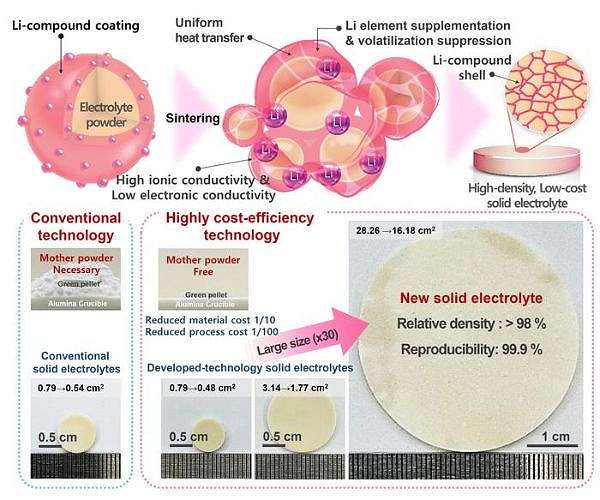
To limit lithium loss, manufacturers have relied on a sintering approach that buries the electrolyte membrane in a large quantity of lithium containing mother powder. This sacrificial material helps maintain lithium activity during sintering but results in more than ten times the amount of mother powder being discarded compared to the mass of usable electrolyte, sharply increasing production costs and hindering large scale adoption.

The KRISS Emerging Material Metrology Group has developed a different approach that coats garnet type solid electrolyte powders with lithium aluminum oxide (Li Al O) based multifunctional compounds before sintering. This thin surface coating supplies lithium locally during high temperature processing and acts as a barrier to lithium evaporation from the membrane.

The coating also promotes a soldering like effect at particle contacts, enhancing interparticle bonding and driving higher densification during sintering. Using this method, the team reports solid electrolyte membranes with a relative density above 98.2 percent without the use of expensive mother powder, producing high strength structures with minimal chemical or mechanical defects.

Ion transport performance improved significantly, with ionic conductivity more than doubling compared to conventionally processed garnet electrolytes. At the same time, electronic conductivity dropped by more than a factor of 20, reducing parasitic internal current leakage and further improving both efficiency and safety in all solid state cell designs that use these membranes.

The process also supports larger format manufacturing. The researchers fabricated solid electrolyte membranes with an area of 16 square centimeters, more than ten times the area of standard laboratory pellets, while achieving a reported yield of 99.9 percent. The combination of high density, large area scalability and very low scrap rates addresses long standing barriers to industrial production.

Dr. Baek Seung Wook, Principal Research Scientist in the Emerging Material Metrology Group at KRISS, said the work resolves materials and process challenges that have persisted for over two decades in garnet solid electrolyte research. He stated that by sharply cutting production costs, the new process is expected to accelerate commercialization of oxide based all solid state batteries and support innovation in energy storage and electric vehicle markets.

Postdoctoral researcher Dr. Kim Hwa Jung noted that Korea currently imports all garnet type solid electrolyte pellets at a unit cost exceeding 550 US dollars for discs with a diameter of only 1 centimeter. The ability to produce high value solid electrolyte membranes domestically using a mother powder free process is expected to strengthen the local supply chain for next generation battery materials.

The research was carried out in collaboration with Professor Park Hyeokjun and colleagues in the Department of Materials Science and Engineering at Korea University. The project received support from the Ministry of Science and ICT and the National Research Foundation of Korea through the Nano and Materials Technology Development Program.

According to KRISS, the results appear in the January issue of the journal Materials Today, which reports an impact factor of 22.0 and a Journal Citation Reports ranking in the top 3.5 percent of its field. The paper is titled "Revitalizing multifunctionality of Li Al O system enabling mother powder free sintering of garnet type solid electrolytes" and documents the development and performance of the coated powder process.

Research Report: Revitalizing multifunctionality of Li Al O system enabling mother powder free sintering of garnet type solid electrolytes

Related Links
Korea Research Institute of Standards and Science
Powering The World in the 21st Century at Energy-Daily.com

Subscribe Free To Our Daily Newsletters
Tweet

RELATED CONTENT
The following news reports may link to other Space Media Network websites.
ENERGY TECH
Perovskite betavoltaic cell sets record efficiency using carbon 14 source
Tokyo, Japan (SPX) Jan 13, 2026
A research team at DGIST has developed a perovskite based self powered betavoltaic battery that achieves what they report as the worlds highest conversion efficiency for this class of device while maintaining long term operational stability. The work targets applications that require continuous reliable power without external charging, such as artificial intelligence systems, internet of things devices, and space exploration hardware operating in harsh or inaccessible environments. The team, led b ... read more

ENERGY TECH
Understanding ammonia energy's tradeoffs around the world

Cold winter and AI boom pushed US emissions increase in 2025

France climate goals off track as emissions cuts slow again

Microsoft says will foot AI's massive power bill as emissions soar in 2025

ENERGY TECH
Perovskite betavoltaic cell sets record efficiency using carbon 14 source

UK facility scales hydrogen recycling of rare earth magnets

Volvo Cars pauses battery factory after fruitless partner search

Lithium ion battery study on Tiangong space station explores microgravity effects on performance

ENERGY TECH
UK nets record offshore wind supply in renewables push

Trump gets wrong country, wrong bird in windmill rant

S.Africa seeks to save birds from wind turbine risks

Vertical wind turbines may soon power UK railways using tunnel airflow

ENERGY TECH
Hebrew University team develops flexible color tunable solar window technology

Spacer layout boosts performance of single component organic solar cells

Quantum simulator sheds light on how nature moves energy in systems like photosynthesis and solar conversion

Theory links photon condensation and heat engine physics

ENERGY TECH
Radioactive zinc shipment in Philippines onshore in 'safe' location

Russia, Ukraine agree 'localised ceasefire' for nuclear plant repairs: IAEA

Bayesian neural net sharpens thorium 232 fission yield data

jaslovske-nuclear-slovakia-npp-hg.jpgpremier to meet Trump, eyeing nuclear plant deal

ENERGY TECH
Biochar layer boosts hydrogen rich gas yields from corn straw

Carbon monoxide enables rapid atomic scale control for fuel cell catalysts

Singapore sets course for 'green' methanol ship fuel supplies

Methane conversion enabled by iron catalyst delivers pharmaceutical compounds

ENERGY TECH
Chinese villagers struggle for heat as gas subsidies fade

Oil prices drop 3% after Trump comments on Iran

Polymer nanoparticles drive platinum free solar hydrogen

Japan protests China gas drilling in East China Sea

ENERGY TECH
Trump pulls US out of key climate treaty, deepening global pullback

German emissions cuts slow, North Sea has warmest year on record

How Climate Policies that Incentivize and Penalize Can Drive the Clean Energy Transition

Regional temperature records broken across the world in 2025

Subscribe Free To Our Daily Newsletters


The content herein, unless otherwise known to be public domain, are Copyright 1995-2024 - Space Media Network. All websites are published in Australia and are solely subject to Australian law and governed by Fair Use principals for news reporting and research purposes. AFP, UPI and IANS news wire stories are copyright Agence France-Presse, United Press International and Indo-Asia News Service. ESA news reports are copyright European Space Agency. All NASA sourced material is public domain. Additional copyrights may apply in whole or part to other bona fide parties. All articles labeled "by Staff Writers" include reports supplied to Space Media Network by industry news wires, PR agencies, corporate press officers and the like. Such articles are individually curated and edited by Space Media Network staff on the basis of the report's information value to our industry and professional readership. Advertising does not imply endorsement, agreement or approval of any opinions, statements or information provided by Space Media Network on any Web page published or hosted by Space Media Network. General Data Protection Regulation (GDPR) Statement Our advertisers use various cookies and the like to deliver the best ad banner available at one time. All network advertising suppliers have GDPR policies (Legitimate Interest) that conform with EU regulations for data collection. By using our websites you consent to cookie based advertising. If you do not agree with this then you must stop using the websites from May 25, 2018. Privacy Statement. Additional information can be found here at About Us.