Many people are optimistic about ammonia's potential as an energy source and carrier of hydrogen, and though large-scale adoption would require major changes to the way it is currently manufactured, ammonia does have a number of advantages. For one thing, ammonia is energy-dense and carbon-free. It is also already produced at scale and shipped around the world, primarily for use in fertilizer.
Though current manufacturing processes give ammonia an enormous carbon footprint, cleaner ways to make ammonia do exist. A better understanding of how to guide the ammonia fuel industry's continued development could improve carbon emissions, energy costs, and regional energy balances.
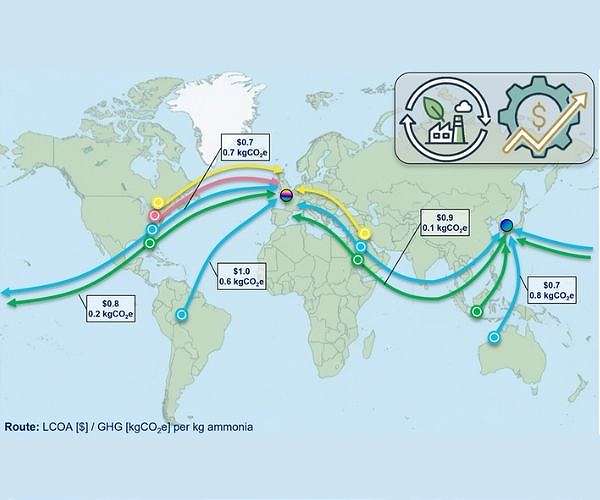
In a new paper, MIT Energy Initiative (MITEI) researchers created the largest combined dataset showing the economic and environmental impact of global ammonia supply chains under different scenarios. They examined potential ammonia flows across 63 countries and considered a variety of country-specific economic parameters as well as low- and no-carbon ammonia production technologies. The results should help researchers, policymakers, and industry stakeholders calculate the cost and lifecycle emissions of different ammonia production technologies and trade routes.
"This is the most comprehensive work on the global ammonia landscape," says senior author Guiyan Zang, a research scientist at MITEI. "We developed many of these frameworks at MIT to be able to make better cost-benefit analyses. Hydrogen and ammonia are the only two types of fuel with no carbon at scale. If we want to use fuel to generate power and heat, but not release carbon, hydrogen and ammonia are the only options, and ammonia is easier to transport and lower-cost."
The study provides the clearest view yet of the tradeoffs associated with various ammonia production technologies. The researchers found, for instance, that a full transition to ammonia produced using conventional processes paired with carbon capture could cut global greenhouse gas emissions by nearly 71 percent for a 23.2 percent cost increase. A transition to electrolyzed ammonia produced using renewable energy could reduce greenhouse gas emissions by 99.7 percent for a 46 percent cost increase.
"Before this, there were no harmonized datasets quantifying the impacts of this transition," says lead author Woojae Shin, a postdoc at MITEI. "Everyone is talking about ammonia as a super important hydrogen carrier in the future, and also ammonia can be directly used in power generation or fertilizer and other industrial uses. But we needed this dataset. It's filling a major knowledge gap."
The paper appears in Energy and Environmental Science. Former MITEI postdocs Haoxiang Lai and Gasim Ibrahim are also co-authors.
Filling a data gap
Today ammonia is mainly produced through the Haber-Bosch process, which in 2020 was responsible for about 1.8 percent of global greenhouse gas emissions. Although current ammonia production is energy-intensive and polluting (referred to as gray ammonia), ammonia can also be produced sustainably using renewable sources (green ammonia) or with natural gas and carbon sequestration (blue ammonia).
As ammonia has increasingly attracted interest as a carbon-free energy source and a medium for hydrogen transport, it's become more important to quantify the costs and life-cycle emissions associated with various ammonia production technologies, as well as ammonia storage and shipping routes. But existing studies were too narrowly focused.
"The previous studies and datasets were fragmented," Shin says. "They focused on specific regions or single technologies, like gray ammonia only, or blue ammonia only. They would also only cover the cost or the greenhouse emissions of ammonia in isolation. Finally, they use different scopes and methodologies. It meant you couldn't make global comparisons or draw definitive conclusions."
To build their database, the MIT researchers combined data from dozens of studies analyzing specific technologies, regions, economic parameters, and trade flows. They also used frameworks they previously developed to calculate the total cost of ammonia production in each country and estimated lifecycle greenhouse gas emissions across the supply chain, factoring in storage and shipping between different regions.
Emissions calculations included activities related to feedstock extraction, production, transport, and import processing. Major cost factors included each country's renewable and grid electricity prices, natural gas prices, and location. Other factors like interest rates and equity premiums were also included.
The researchers used their calculations to find ammonia costs and life cycle emissions across six ammonia production technologies. In the context of the U.S. average, they found the lowest production cost came from using a popular form of the Haber Bosch process known as natural gas steam methane reforming (SMR) without carbon capture and storage (gray ammonia), at 48 cents per kilogram of ammonia. Unfortunately, that economic advantage came with the highest greenhouse gas emissions, at 2.46 kilograms of CO2 equivalent per kilogram of ammonia. In contrast, SMR with carbon capture and storage achieves an approximately 61 percent reduction in emissions while incurring a 29 percent increase in production costs.
Another method for producing ammonia that uses natural gas as a feedstock called auto-thermal reforming (ATR) with air combustion, when combined with carbon capture and storage, exhibited a 10 percent higher cost than conventional SMR while generating emissions of 0.75 kilograms of CO2 equivalent per kilogram of ammonia, representing a more cost-effective decarbonization option than SMR with carbon capture and storage.
Among production pathways including carbon capture (blue ammonia), a variation of ATR that uses oxygen combustion and carbon capture had the lowest emissions, with a production cost of about 57 cents per kilogram of ammonia. Producing ammonia with electricity generally had higher production costs than blue ammonia pathways. When nuclear energy is powering ammonia production, as opposed to the grid, greenhouse gas emissions are near zero at 0.03 kilograms of CO2 equivalent per kilogram of ammonia produced.
Across the 63 countries studied, major cost and emissions differences were driven by energy costs, sources of energy for the grid, and financing environments. China emerged as an optimal future supplier of green ammonia to many countries, while the Middle East also offered competitive low-carbon ammonia production pathways. Generally, blue ammonia pathways are most attractive for countries with low-cost natural gas resources, and ammonia made using grid electricity proved more expensive and more carbon-intensive than conventionally produced ammonia.
From data to policy
Low-carbon ammonia use is projected to grow dramatically by 2050, with that ammonia procured via global trade. Japan and Korea, for example, have included ammonia in their national energy strategies and conducted trials using ammonia to generate power. They even offer economic credits for verified CO2 reductions from clean ammonia projects.
"Ammonia researchers, producers, as well as government officials require this data to understand the impact of different technologies and global supply corridors," Shin says.
The authors also believe industry stakeholders and other researchers will get a lot of value from their database, which allows users to explore the impact of changing specific parameters.
"We collaborate with companies, and they need to know the full costs and lifecycle emissions associated with different options," Zang says. "Governments can also use this to compare options and set future policies. Any country producing ammonia needs to know which countries they can deliver to economically."
The research was supported by the MIT Energy Initiative's Future Energy Systems Center.
Research Report:Toward a sustainable energy future using ammonia as an energy carrier: global supply chain cost and greenhouse gas emissions