A team of materials scientists has developed a bio based carbon aerogel derived from chitin that improves thermal energy storage in shape stabilized phase change materials while addressing leakage during melting.
Phase change materials store and release heat as they melt and solidify, so they are used in building temperature control, solar thermal storage, and electronic thermal management. Many organic phase change materials leak when they melt, which reduces service life and limits practical deployment.
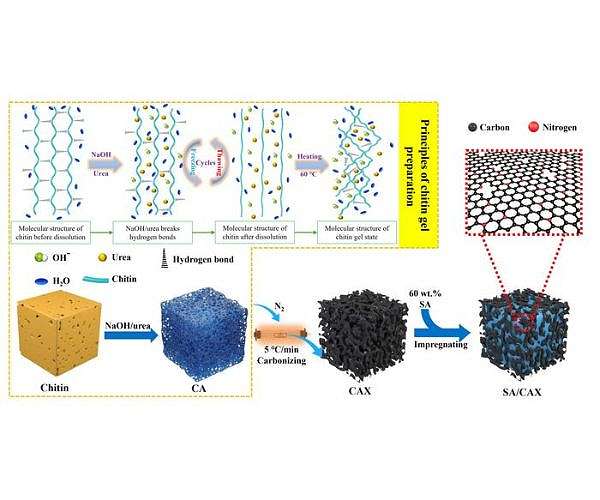
In the study published in Sustainable Carbon Materials, researchers converted chitin, a natural polymer found in crustacean shells and fungi, into an ultralight aerogel and then carbonized it to obtain a porous carbon framework. This chitin derived carbon aerogel encapsulated stearic acid, a commonly studied organic phase change material, yielding a shape stabilized composite that keeps its solid form even when the stearic acid phase changes to liquid.
"Our goal was to design a low cost and environmentally friendly support that can hold large amounts of phase change material without leakage," said corresponding author Hui Li. "Chitin is abundant, renewable, and naturally rich in nitrogen, which makes it especially attractive for this purpose."
The carbon aerogel exhibits an interconnected pore structure with a large pore volume that accommodates molten stearic acid. Capillary forces and hydrogen bonding between the aerogel surface and stearic acid molecules prevent the liquid from escaping, allowing the composite to contain up to sixty percent stearic acid by weight with no visible leakage.
Thermal measurements showed that the composite reaches a melting enthalpy of about 118 joules per gram, giving it a high thermal storage density. This value exceeds those of many previously reported biomass derived phase change composites and is accompanied by higher thermal conductivity than pure stearic acid, which supports faster heat absorption and release.
Durability tests indicated that the material maintains stable performance during repeated operation. After one hundred heating and cooling cycles, the composite preserved nearly the same phase change temperature and retained more than ninety seven percent of its initial heat storage capacity, while structural and chemical characterization confirmed that the carbon framework remained intact.
"Long term reliability is essential for real world energy storage systems," said Hui Li. "Our results show that this chitin based carbon aerogel can repeatedly store and release heat without structural degradation."
The researchers reported that the carbon aerogel raises the activation energy for the phase change of stearic acid, reflecting enhanced thermal stability. They attribute this effect to nanoscale confinement of the phase change material within the pores and hydrogen bonding interactions with the nitrogen doped carbon surface.
Because chitin can be recovered from seafood processing waste, the approach links waste valorization with energy storage technology. The team notes that the same strategy could be adapted to other phase change materials and tuned for different temperature windows.
"This work shows how sustainable carbon materials can address both energy efficiency and environmental concerns," Hui Li said. "It opens new possibilities for greener thermal energy storage technologies in buildings, electronics, and renewable energy systems."
The study illustrates how combining natural polymers with porous carbon design can produce practical thermal energy storage materials while reducing dependence on fossil derived resources.
Research Report:Chitin aerogel-derived carbon for shape-stabilized phase change materials with enhanced thermal energy storage