
Energy News
ENERGY TECH
EAST experiments point to density free regime for fusion plasmas
illustration only

EAST experiments point to density free regime for fusion plasmas

by Riko Seibo
Tokyo, Japan (SPX) Jan 03, 2026

Researchers working on China's fully superconducting Experimental Advanced Superconducting Tokamak (EAST) have experimentally accessed a theorized density-free regime for fusion plasmas, maintaining stable operation at densities that exceed conventional empirical limits.

The results, reported in Science Advances on January 1, address a long-standing physical constraint on the path toward nuclear fusion ignition by showing that plasma density limits in tokamaks can be relaxed without triggering disruptive instabilities.

The study was co-led by Prof. ZHU Ping of Huazhong University of Science and Technology and Associate Prof. YAN Ning of the Hefei Institutes of Physical Science, Chinese Academy of Sciences, who implemented a new high-density operating scheme on EAST to extend the achievable density range.

For deuterium-tritium fusion reactions, plasmas must be heated to an optimal temperature of around 13 keV, corresponding to about 150 million kelvin, and under these conditions thermonuclear power output scales with the square of the fuel density.

In conventional tokamak operation, however, plasma density has long been restricted by an empirical upper limit, beyond which instabilities typically arise, degrade confinement, and jeopardize the safe operation of the device, limiting efforts to raise fusion performance.

A recently developed plasma - wall self organization (PWSO) theory offers a new perspective on this disruptive density limit, having been proposed by D.F. Escande and colleagues at the French National Center for Scientific Research and Aix-Marseille University to describe how plasmas and metallic walls can co-evolve under conditions dominated by physical sputtering.

According to PWSO, a density-free regime becomes accessible if the plasma and wall reach a specific balance in which sputtering and impurity dynamics allow higher densities without driving disruptive events, effectively removing the traditional density cap.

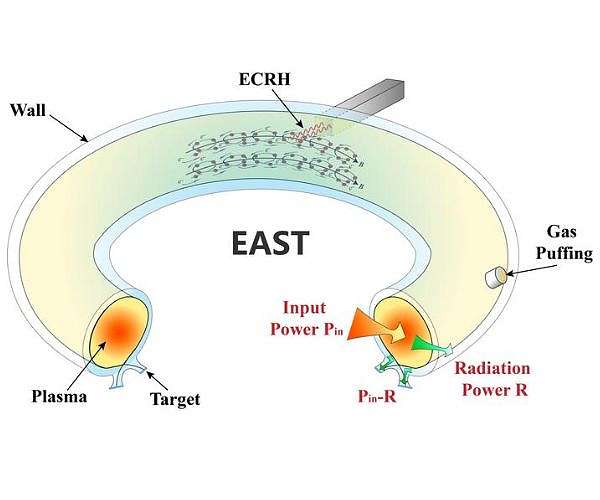
The EAST experiments verify this physical concept for the first time by combining control of the initial fuel gas pressure with electron cyclotron resonance heating during the start-up phase of the discharge.

This approach enables optimization of plasma - wall interactions from the earliest moments of the discharge, so that impurity influx and associated energy losses are reduced as the plasma current and temperature rise.

With impurity accumulation and plasma - wall interactions suppressed, the plasma density can be increased throughout start-up, eventually reaching values at the end of this phase that would typically be associated with instability and disruption in standard operation.

Under these conditions, the team reports that EAST accessed the density-free regime predicted by PWSO theory, with the plasma remaining stable even when operating at densities that far exceeded empirical limits documented in earlier tokamak studies.

These experimental results provide new physical insight into how the density limit in tokamak operation can be overcome and are viewed as an important step toward realizing fusion ignition in future burning plasma devices.

"The findings suggest a practical and scalable pathway for extending density limits in tokamaks and next-generation burning plasma fusion devices," said Prof. ZHU.

Associate Prof. YAN added that the research team plans to apply the new method during high-confinement operation on EAST in the near future in an attempt to access the density-free regime under high-performance plasma conditions.

Research Report:Accessing the density-free regime with ECRH-assisted ohmic start-up on EAST

Related Links
Hefei Institutes of Physical Science
Powering The World in the 21st Century at Energy-Daily.com

Subscribe Free To Our Daily Newsletters
Tweet

RELATED CONTENT
The following news reports may link to other Space Media Network websites.
ENERGY TECH
Physicists map axion production paths inside deuterium tritium fusion reactors
Los Angeles CA (SPX) Jan 01, 2026
A University of Cincinnati physicist and collaborators from Fermi National Accelerator Laboratory MIT and Technion-Israel Institute of Technology have developed a theoretical framework showing how axions or axion like particles could be produced and studied in deuterium tritium fusion reactors lined with lithium. Their analysis builds on a recurring joke arc in the television series The Big Bang Theory where fictional physicists Sheldon Cooper and Leonard Hofstadter struggle to work out axion prod ... read more

ENERGY TECH
France updates net-zero plan, with fossil fuel phaseout; Fight over fossil fuels nixes key text of UN environment report

EU agrees to weaken and delay green business rules

Policies to expand US grid weigh cost reliability and emissions

Keep energy infrastructure out of war, Turkey warns Moscow, Kyiv

ENERGY TECH
Chitin based carbon aerogel boosts stable thermal energy storage

Redesigned carbon framework boosts battery safety and power

Molecular catalyst switches between hydrogen and oxygen production

China's rare earths El Dorado gives strategic edge

ENERGY TECH
Trump gets wrong country, wrong bird in windmill rant

S.Africa seeks to save birds from wind turbine risks

Vertical wind turbines may soon power UK railways using tunnel airflow

Danish wind giant Orsted to cut workforce by a quarter

ENERGY TECH
PCBM additive strategy lifts efficiency and durability of inverted perovskite solar cells

NUS team boosts durability of vapor deposited perovskite silicon tandem solar cells

Bilayer tin oxide layer boosts back contact perovskite solar cell efficiency and stability

Germanium oxide interface boosts tin monosulfide thin film solar cell efficiency and stability

ENERGY TECH
Project Pele microreactor reaches key milestone with first TRISO fuel delivery

Microbes join forces to quickly clean up uranium pollution

India's parliament passes bill to open nuclear power to private firms

New analysis links lead cooled reactor corrosion to steel microstructure

ENERGY TECH
Biochar layer boosts hydrogen rich gas yields from corn straw

Carbon monoxide enables rapid atomic scale control for fuel cell catalysts

Singapore sets course for 'green' methanol ship fuel supplies

Methane conversion enabled by iron catalyst delivers pharmaceutical compounds

ENERGY TECH
Hydrogen plays part in global warming: study

ExxonMobil slows low-carbon investment push through 2030

Israel, Qatar and US hold trilateral meeting in New York

Lula orders road map to cut fossil-fuel use in Brazil

ENERGY TECH
Turkmenistan's battle against desert sand

Rain in Tehran brings relief from nationwide drought

US agency wipes climate change facts from website: reports

To counter climate denial, UN scientists must be 'clear' about human role: IPCC chief

Subscribe Free To Our Daily Newsletters


The content herein, unless otherwise known to be public domain, are Copyright 1995-2024 - Space Media Network. All websites are published in Australia and are solely subject to Australian law and governed by Fair Use principals for news reporting and research purposes. AFP, UPI and IANS news wire stories are copyright Agence France-Presse, United Press International and Indo-Asia News Service. ESA news reports are copyright European Space Agency. All NASA sourced material is public domain. Additional copyrights may apply in whole or part to other bona fide parties. All articles labeled "by Staff Writers" include reports supplied to Space Media Network by industry news wires, PR agencies, corporate press officers and the like. Such articles are individually curated and edited by Space Media Network staff on the basis of the report's information value to our industry and professional readership. Advertising does not imply endorsement, agreement or approval of any opinions, statements or information provided by Space Media Network on any Web page published or hosted by Space Media Network. General Data Protection Regulation (GDPR) Statement Our advertisers use various cookies and the like to deliver the best ad banner available at one time. All network advertising suppliers have GDPR policies (Legitimate Interest) that conform with EU regulations for data collection. By using our websites you consent to cookie based advertising. If you do not agree with this then you must stop using the websites from May 25, 2018. Privacy Statement. Additional information can be found here at About Us.