|
 |
 |
 |
 |
 |
 |
 |
 |

 |
UN calls for action after Lebanese slick spreads to Syria
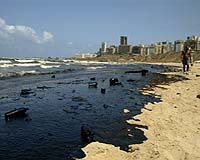
Nairobi, Kenya (AFP) Aug 02, 2006 The UN Environment Programme (UNEP) on Wednesday called for immediate action after thousands of tonnes of fuel from a bombed Lebanese power plant spread to the Syrian coastline, threatening to unleash an environmental catastrophe. The Nairobi-based UNEP said the oil slick, caused by the destruction of the Jiyyeh power utility 30 kilometres (18 miles) south of Beirut, had arrived on Syria's coast after affecting up to 80 kilometres (50 miles) of the Lebanese coastline. "It is nearly three weeks since the bombing of the power plant and the initial satellite imagery unfortunately confirms that the oil spill is of a significant magnitude and spreading," UNEP executive director Achim Steiner said in a statement released here. "A coordinated response must urgently be allowed to proceed, so that we can limit the immediate environmental damage as well as the longer terms implications for the economy and the Lebanese people," he added. "Now it has become even more vital to take immediate action. In addition to the humanitarian circumstances, an environmental catastrophe is threatening the Mediterranean region," said Paul Mifsud, UNEP's coordinator for the Mediterranean Action Plan. "Hostilities must cease to guarantee immediate safe access to the affected area," he said, echoeing calls by a section of the international community. Israeli forces bombed the tanks at the power station on July 14 and July 15, a few days into their offensive on Lebanon which has seen intensive air strikes across the country and a bloody ground incursion in the south. The leak from one of the tanks, located just 25 metres (80 feet) from the sea, has now stopped but another containing 25,000 tonnes of fuel oil is still on fire and is in danger of exploding. Between 8,000 and 10,000 tonnes of fuel are on the shore and 5,000 on open waters of the Lebanese coastline. UNEP said it had received a letter from Syria's Minister for Local Administration and Environment Helal Al-Atrash asking it "to send professional companies to control the spilled oil on the shoreline and territorial waters ... and to send experts for the assessment of environmental degradation costs." According to Oceanographic Centre of Cyprus, 80 percent of the oil remains on and off the Lebanese shoreline, while less than 20 percent has evaporated. The agency said Algeria, Cyprus, the European Community, France, Italy, Malta, Spain and Syria have responded to appeals and the Malta-based Regional Marine Pollution Emergency Response Center for the Mediterranean Sea (REMPEC) is giving daily advice to the Lebanese environment ministry on how to tackle the the slick. Over the weekend, Lebanese Environment Minister Yacub Sarraf told AFP between 10,000 and 15,000 tonnes of heavy fuel oil have spilled out into the sea, covering once golden beaches and rocks with black sludge. Sarraf said cleaning up Lebanon's beaches -- which until the bombardment were major attractions for locals and tourists -- would cost between 45 and 50 million dollars and would not be finished until next summer. Community Email This Article Comment On This Article Related Links UN Environment Programme Our Polluted World and Cleaning It Up
 At An Underwater Volcano, Evidence Of Man's Environmental Impact
 Gainseville FL (SPX) Aug 02, 2006
Scientists studying hydrothermal vents, those underwater geysers that are home to bizarre geological structures and unique marine species, have discovered something all too familiar: pollution. |
|
|

| The content herein, unless otherwise known to be public domain, are Copyright 1995-2006 - SpaceDaily.AFP and UPI Wire Stories are copyright Agence France-Presse and United Press International. ESA PortalReports are copyright European Space Agency. All NASA sourced material is public domain. Additionalcopyrights may apply in whole or part to other bona fide parties. Advertising does not imply endorsement,agreement or approval of any opinions, statements or information provided by SpaceDaily on any Web page published or hosted by SpaceDaily. Privacy Statement |