|
 |
 |
 |
 |
 |
 |
 |
 |

 |
No Lunar Polar Ice Sheets Found In High Resolution Radar Images
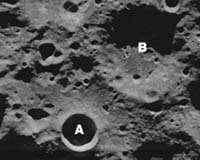
Ithaca NY (SPX) Oct 19, 2006 Using the highest resolution radar-signal images ever made of the moon - images from the National Science Foundation's (NSF) Arecibo Telescope in Arecibo, P.R., and the NSF's Robert C. Byrd Telescope in Green Bank, W.Va. - planetary astronomers have found no evidence for ice in craters at the lunar south pole. Cornell University, Smithsonian Institution and Australian scientists report the findings in the latest Nature (Oct. 19, 2006). "These new results do not preclude ice being present as small grains in the lunar soil based on the Lunar Prospector's discovery of enhanced hydrogen concentrations at the lunar poles," said Donald Campbell, Cornell professor of astronomy and a principal investigator. "There is always the possibility that concentrated deposits exist in a few of the shadowed locations not visible to radars on Earth, but any current planning for landers or bases at the lunar poles should not count on this." Echoes from radar signals transmitted to the moon from the giant Arecibo telescope were received at the Green Bank telescope. These echoes allowed scientists from Cornell, the Smithsonian Institution and the Defence Science and Technology Organization in Australia to create images, offering the best view ever of the shadowed terrain at the lunar south pole. Since the 1960s, theories have suggested that ice may exist deep inside impact craters in permanent shadow from the sun, where temperatures on the moon's surface do not exceed minus 280 degrees Fahrenheit (or minus 173 Centigrade), at the poles. The theory was bolstered in 1992 when Earth-based radar telescopes located "ice deposits" inside impact craters at the poles of the planet Mercury. The Lunar Prospector orbiter discovered concentrations of hydrogen at the moon's poles. If this hydrogen were in the form of water molecules - still a subject of debate - then it would correspond to an average of 1 to 2 percent of water ice in the lunar soil in the shadowed terrain. However, Earth-based radar measurements since the 1990s have consistently failed to detect ice deposits similar to those on Mercury. Since water ice would be a significant resource for any future lunar base, many of the instruments on NASA's 2008 Lunar Reconnaissance Orbiter/Lunar Crater Observation and Sensing Satellite mission seek to learn if water ice is present in permanently shadowed craters. Even in the lunar summer at the south pole, the sun barely edges above the horizon, thus the bottom impact craters never see the sun. Because of the tilt of the moon's orbital plane relative to the Earth's equatorial plane, the Earth can rise much higher above the horizon at the lunar south pole than the sun, so telescopes on the Earth can "see" some of the shadowed area. However, since that area is permanently in shadow, only radar can image that terrain. Donald Campbell and Jean-Luc Margot of Cornell University, Bruce Campbell and Lynn Carter of the Smithsonian Institution, and Nicholas Stacy of the Australian Defence Science and Technology Organization conducted the research. Cornell's National Astronomy and Ionosphere Center manages the Arecibo telescope, and the Green Bank Telescope is part of the National Radio Astronomy Observatory, which is operated by Associated Universities Inc. for the NSF. Community Email This Article Comment On This Article Related Links Cornell University Lunar Dreams and more Mars News and Information at MarsDaily.com Lunar Dreams and more
 Ice Store At Moon's South Pole Is A Myth
 Paris (AFP) Oct 18, 2006
Hopes that the Moon's South Pole has a vast hoard of ice that could be used to establish a lunar colony are sadly unfounded, a new study says. In 1994, radar echoes sent back in an experiment involving a US orbiter called Clementine appeared to show that a treasure trove of frozen water lay below the dust in craters near the lunar South Pole that were permanently shaded from the Sun. |
|
|

| The content herein, unless otherwise known to be public domain, are Copyright 1995-2006 - SpaceDaily.AFP and UPI Wire Stories are copyright Agence France-Presse and United Press International. ESA PortalReports are copyright European Space Agency. All NASA sourced material is public domain. Additionalcopyrights may apply in whole or part to other bona fide parties. Advertising does not imply endorsement,agreement or approval of any opinions, statements or information provided by SpaceDaily on any Web page published or hosted by SpaceDaily. Privacy Statement |