|
 |
 |
 |
 |
 |
 |
 |
 |

 |
Ice Store At Moon's South Pole Is A Myth
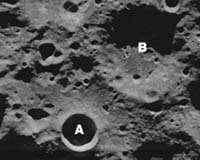
Paris (AFP) Oct 18, 2006 Hopes that the Moon's South Pole has a vast hoard of ice that could be used to establish a lunar colony are sadly unfounded, a new study says. In 1994, radar echoes sent back in an experiment involving a US orbiter called Clementine appeared to show that a treasure trove of frozen water lay below the dust in craters near the lunar South Pole that were permanently shaded from the Sun. If so, such a find would be an invaluable boost to colonisation, as the ice could be used to provide water as well as hydrogen as fuel. NASA is looking closely at the South Pole as a potential site for the United States' return mission to the Moon, scheduled to take place by 2020. But a paper published in the British science journal Nature on Thursday by a US team says the Clementine data most probably was misinterpreted. Donald Campbell of Washington's Smithsonian Institution and colleagues collected radar images of the Moon's South Pole to a resolution of 20 metres (65 feet), looking especially at Shackleton crater, which had generated most interest. The team found that a particular radar signature called the circular polarization ratio -- which in the Clementine experiment was taken to indicate thick deposits of ice -- could also be created by echoes from the rough terrain and walls of impact craters. The signature was found in both sunny and permanently shady areas of crater, which suggests that the reflection comes from rocky debris, not thick ice deposits. If there is any ice at the South Pole, it probably comes from tiny, scattered grains that probably account for only one or two percent of the local dust, the authors suggest. "Any planning for future exploitation of hydrogen at the Moon's South Pole should be constrained by this low average abundance rather than by the expectation of localised deposits at higher concentrations," the paper says soberly. The research involved sending a radar signal from the Arecibo telescope in Puerto Rico. The signal hit the southern lunar region and the reflection was picked up by the Green Bank Telescope in West Virginia.
Source: Agence France-Presse Community Email This Article Comment On This Article Related Links Smithsonian Institution Lunar Dreams and more Mars News and Information at MarsDaily.com Lunar Dreams and more
 New Russian Spaceship Will Be Able To Fly To Moon - Space Corp
 Zvyozdny Gorodok (RIA Novosti) Oct 19, 2006
Russia's Rocket and Space Corporation Energia said Wednesday it will create a new spaceship capable of flying to the Moon. "We have started developing the final design of a modernized spaceship that has been given the working name of Soyuz-K," Nikolai Sevastyanov, the corporation's president, told RIA Novosti. |
|
|

| The content herein, unless otherwise known to be public domain, are Copyright 1995-2006 - SpaceDaily.AFP and UPI Wire Stories are copyright Agence France-Presse and United Press International. ESA PortalReports are copyright European Space Agency. All NASA sourced material is public domain. Additionalcopyrights may apply in whole or part to other bona fide parties. Advertising does not imply endorsement,agreement or approval of any opinions, statements or information provided by SpaceDaily on any Web page published or hosted by SpaceDaily. Privacy Statement |