|
 |
 |
 |
 |
 |
 |
 |
 |

 |
Marine Life Stirs Ocean Enough To Affect Climate
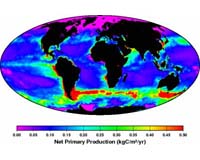
Tallahassee FL (SPX) Oct 16, 2006 Oceanographers worldwide pay close attention to phytoplankton and with good reason. The microscopic plants that form the vast foundation of the marine food chain generate a staggering amount of power, and now a groundbreaking study led by Florida State University has calculated just how much -- about five times the annual total power consumption of the human world. Physical and biological oceanographers led by FSU Professor William Dewar put the yearly amount of chemical power stored by phytoplankton in the form of new organic matter at roughly 63 terawatts, and that's a lot of juice: Just one terawatt equals a trillion watts. In 2001, humans collectively consumed a comparatively measly 13.5 terawatts. What's more, their study found that the marine biosphere -- the chain of sea life anchored by phytoplankton -- invests around one percent (1 terawatt) of its chemical power fortune in mechanical energy, which is manifested in the swimming motions of hungry ocean swimmers ranging from whales and fish to shrimp and krill. Those swimming motions mix the water much as cream is stirred into coffee by swiping a spoon through it. And the sum of all that phytoplankton-fueled stirring may equal climate control. "By interpreting existing data in a different way, we have predicted theoretically that the amount of mixing caused by ocean swimmers is comparable to the deep ocean mixing caused by the wind blowing on the ocean surface and the effects of the tides," Dewar said. In fact, he explained, biosphere mixing appears to provide about one third the power required to bring the deep, cold waters of the world ocean to the surface, which in turn completes the ocean's conveyor belt circulation critical to the global climate system. Findings from the FSU-led study ("Does the marine biosphere mix the ocean?") will appear in the forthcoming issue of the Journal of Marine Research, adding the role of major power broker to phytoplankton's already impressive credentials. Scientists for some time have known that the highly sensitive plants act as reliable signals of environmental changes at or near the ocean surface through sudden declines or rapid growth -- and they have suspected that phytoplankton affect as well as reflect climate change when large, sustained plant populations gulp carbon dioxide from the atmosphere during grand-scale photosynthesis. But along with the new calculations that point to the marine biosphere's bigger-than-expected role in ocean mixing and climate control, Dewar and his colleagues also suggest that human and environmental decimation of whale and big fish populations may have had a measurable impact on the total biomixing occurring in the world's oceans. Community Email This Article Comment On This Article Related Links Florida State University Learn about Climate Science at TerraDaily.com Climate Science News - Modeling, Mitigation Adaptation
 Extreme Environment Changes Fish Appearance
 Davis CA (SPX) Oct 16, 2006
The world of the Devils Hole pupfish is a small place. The entire species lives in one rocky pool, 20 meters long and three meters wide, in a cave entrance in Death Valley, Calif. But their environment is not only cramped: it also has a profound effect on the fishes' appearance, raising questions about how rare species can be protected from extinction. |
|
|

| The content herein, unless otherwise known to be public domain, are Copyright 1995-2006 - SpaceDaily.AFP and UPI Wire Stories are copyright Agence France-Presse and United Press International. ESA PortalReports are copyright European Space Agency. All NASA sourced material is public domain. Additionalcopyrights may apply in whole or part to other bona fide parties. Advertising does not imply endorsement,agreement or approval of any opinions, statements or information provided by SpaceDaily on any Web page published or hosted by SpaceDaily. Privacy Statement |