|
 |
 |
 |
 |
 |
 |
 |
 |

 |
Extreme Environment Changes Fish Appearance
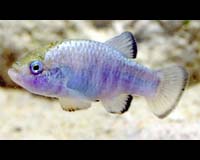
Davis CA (SPX) Oct 16, 2006 The world of the Devils Hole pupfish is a small place. The entire species lives in one rocky pool, 20 meters long and three meters wide, in a cave entrance in Death Valley, Calif. But their environment is not only cramped: it also has a profound effect on the fishes' appearance, raising questions about how rare species can be protected from extinction. In 1976, the inch-long fish was at the center of a legal battle that reached the U.S. Supreme Court. Conservationists had established the fish in refuges elsewhere in case Devil's Hole became too dry. But the refuge-bred fish began to look different, with deeper bodies and smaller heads, although all the fish are pretty much the same genetically. Sean Lema, a graduate student at UC Davis, and Gabrielle Nevitt, professor of neurobiology, physiology and behavior, set out to see if environmental changes could affect how the fish looked. They reared a related but unthreatened species, the Amargosa pupfish, in the lab on a restricted diet and with slight changes in water temperature. The Amargosa pupfish began to look more like the wild Devils Hole pupfish. "Restricting food availability and raising the temperature just a few degrees shifts morphology dramatically," Lema said. The findings have implications for conserving species, Lema said. On one hand, the fish may be more adaptable to changing conditions than thought. But refuge-bred fish might well die if reintroduced directly to Devil's Hole in an attempt to rebuild the population. And if an animal's form is so intimately connected to its environment, is it still the same fish if it is not preserved in the same habitat? "What is it that we try to preserve -- just genetics, or the habitat that makes them unique?" Lema said. The work was supported by the National Science Foundation and is published in the Sept. 15 issue of the Journal of Experimental Biology. Lema is currently a researcher at the NOAA Northwest Fisheries Science Center in Seattle and at the University of Washington. Community Email This Article Comment On This Article Related Links UC Davis Learn about Climate Science at TerraDaily.com Climate Science News - Modeling, Mitigation Adaptation
 Northern Bogs May Have Helped Kick-Start Past Global Warming
 Los Angeles CA (SPX) Oct 13, 2006
Methane gas released by peat bogs in the northern-most third of the globe probably helped fuel the last major round of global warming, which drew the ice age to a close between 11,000 and 12,000 years ago, UCLA and Russian Academy of Sciences scientists have concluded. |
|
|

| The content herein, unless otherwise known to be public domain, are Copyright 1995-2006 - SpaceDaily.AFP and UPI Wire Stories are copyright Agence France-Presse and United Press International. ESA PortalReports are copyright European Space Agency. All NASA sourced material is public domain. Additionalcopyrights may apply in whole or part to other bona fide parties. Advertising does not imply endorsement,agreement or approval of any opinions, statements or information provided by SpaceDaily on any Web page published or hosted by SpaceDaily. Privacy Statement |