|
 |
 |
 |
 |
 |
 |
 |
 |

 |
Landmark Foreign Policy Opinion Poll Criticized
UPI Correspondent Washington (UPI) Oct 17, 2006 A landmark study documenting Asian and American opinion on foreign policy issues has been criticized for its methodology and called "weak" by some experts. The study by the Chicago Council on Global Affairs, entitled "The United States and the Rise of China and India," surveyed about 2,000 people from China, South Korea, Australia, India and America. They were asked their opinion on foreign policy issues such as globalization, terrorism, the rise of China and India and perceived critical threats to their countries. Among its findings, the study revealed the Chinese public is a bigger advocate of free market principles than Americans; 87 percent of the Chinese were positive about globalization and free trade, compared to only 60 percent of Americans. The report attributes this to the "perceived link to job losses" that free trade areas have for Americans. Australians, who have an economy similar to the United States' in many respects, felt a similar way about globalization, with only 64 percent being positive. Analysts say this report dispels the notion that public dissatisfaction over the Iraq war has pushed Americans into an isolationist frame of mind. "The survey findings couldn't be clearer. Americans do not want to retreat to an isolationist foreign policy," Marshall M. Bouton, president of the Chicago Council on Global Affairs, said. "Americans understand that China and India are rising economic and political forces, and want the U.S. government to choose engagement." Surprisingly, the report found that South Koreans see global warming as the most critical threat to their country, while danger from unfriendly nuclear powers ranks only fourth. Indians see themselves, in terms of global influence and technological innovation, as second only to the United States. On these two issues, Indians think they will be an even closer second to the United States in 10 years time. But despite strong indications India will be a leading economic power in the coming years, the Chinese, American and South Korean publics believe India has the lowest world influence out of all the countries measured. Indians, meanwhile, overestimate their world influence, according to the report. Norman Ornstein, a resident fellow at the American Enterprise Institute, was concerned that "India is off the radar screens of the American people. They are and economic power down the road and most American haven't seen this yet." China is perceived to be a rising power by all the nations studied. Americans think that China will be a close second to the United States in 10 years time, while the Chinese recognize they are second to the United States at present and believe they will draw even within a decade. The survey discounted all candidates that were not literate or had no formal education -- eliminating a mere 1.8 percent of Chinese involved but 20 percent of Indian participants -- on the grounds that illiterate and uneducated people had a tendency to guess answers. Kenneth Ballen, president of the public opinion polling organization Terror Free Tomorrow, criticized the decision to exclude the uneducated. He said that "don't knows" can in fact tell you something; for example, that people do not care about the issue in question. Also, "you just don't know what people are going to say until you ask them," he said. More importantly, Ballen added, the decision to discount the uneducated makes comparing countries problematic: The survey of China accounts for 98.2 percent of the population while the survey of India measures only 80 percent, making the China survey more representative of the Chinese population than the Indian one. Comparing the two is therefore like "comparing apples and oranges," according to Ballen. The study, which was so concerned with the rise of India and China, was also criticized for failing to adequately tackle the many possible meanings of the word "rise." Stephen Kull, the director of the Program on International Policy Attitudes, condemned the study as "weak" in this respect. He suggested that a "rise" in a country was not just an increase in technological innovation or influence, as the study seems to suggest. He said that the "rise" of a country can be measured in terms of economic or military progress, but that culture and food are just as important. Kull stressed the significance of increased political freedom and social justice as a gauge of development. "Future studies should really dig more deeply into what 'rise' really means," he said.
Source: United Press International Community Email This Article Comment On This Article Related Links Learn about the Superpowers of the 21st Century at SpaceWar.com Learn about the Superpowers of the 21st Century at SpaceWar.com Learn about nuclear weapons doctrine and defense at SpaceWar.com
 Russia Bending To China Over Expectations On North Korea
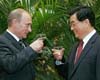 Moscow (AFP) Oct 16, 2006
Russia's cautious approach to supporting sanctions against North Korea reflects a growing desire to please China rather than any fondness for the hardline leadership in Pyongyang, analysts here say. Pragmatism seems to have been the name of the game when Russia set strict pre-conditions before eventually supporting Saturday's US-sponsored resolution on Pyongyang's weapons programme in the United Nations Security Council. |
|
|

| The content herein, unless otherwise known to be public domain, are Copyright 1995-2006 - SpaceDaily.AFP and UPI Wire Stories are copyright Agence France-Presse and United Press International. ESA PortalReports are copyright European Space Agency. All NASA sourced material is public domain. Additionalcopyrights may apply in whole or part to other bona fide parties. Advertising does not imply endorsement,agreement or approval of any opinions, statements or information provided by SpaceDaily on any Web page published or hosted by SpaceDaily. Privacy Statement |