|
 |
 |
 |
 |
 |
 |
 |
 |

 |
Russia Bending To China Over Expectations On North Korea
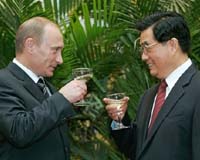
Moscow (AFP) Oct 16, 2006 Russia's cautious approach to supporting sanctions against North Korea reflects a growing desire to please China rather than any fondness for the hardline leadership in Pyongyang, analysts here say. Pragmatism seems to have been the name of the game when Russia set strict pre-conditions before eventually supporting Saturday's US-sponsored resolution on Pyongyang's weapons programme in the United Nations Security Council. "China is a more important player in this field and we're sort of allies... Here we coordinated with China and didn't stick out on our own," Moscow-based defence analyst Pavel Felgenhauer told AFP. In particular, any nostalgia for the friendship between the Soviet Union and North Korea in the early years of its independence has long ago been overtaken under President Vladimir Putin by hard-nosed realism, analysts say. This partly derives from a visit to Pyongyang by Putin in 2000 which led to Putin being humiliated by North Korean leader Kim Jong-il. The visit -- extremely rare for a world leader -- ended with Putin telling Western leaders that Kim had promised to give up his nuclear ambitions, but only days later Kim announced that he had been joking. Putin "hates strongly" Kim Jong-il because of the incident, Felgenhauer said. Return visits by Kim in 2001 and 2002 have done little to cement ties, prompting instead bewilderment at his decision on the first visit to spend weeks travelling by train from North Korea to Saint Petersburg and back again. In the view of Anton Khlopkov, deputy director of the Moscow-based think tank PIR, Russia has genuine reasons to be cautious about being more aggressive towards North Korea, as increased pressure could have dangerous consequences. "It's hard to predict their reaction to sanctions and they don't impinge on the leadership but the people," Khlopkov said, referring to the North Koreans. "They would resort to any lengths to protect their regime." But others say that Russia's reluctance to impose stronger sanctions reflects a lack of serious concern about the nuclear ambitions of North Korea, which shares an 18-kilometre (11-mile) border with Russia's far eastern province of Primorsky. "I don't think Russia is seriously worried about North Korea's nuclear programme. The conventional wisdom is that North Korea wants nuclear weapons not to attack Russia or anyone but to have a symbol of power," said Fyodor Lukyanov, editor of the journal Russia in Global Affairs. Others are disturbed by Russia's willingness to follow the lead of China, which has sought closer ties with Moscow on issues ranging from energy to defence. Vladimir Pribylovsky, head of the Panorama research centre, sees a growing anti-Americanism in Russia's caution on the North Korea issue. In part Russia fears any international approval for forceful regime change because it was deeply shaken by the bombing of Yugoslavia in 1999 by the North Atlantic Treaty Organisation (NATO), he says. "Russia is very afraid of America.... Russia feels the only guarantee that it will not be punished itself is its nuclear weapons and having allies like China, Iran, North Korea and Libya," Pribylovsky said. Moscow's desire to maintain the status quo in North Korea and follow China's lead was sharply criticised Monday by Asia specialist Alexander Lukin, of the Moscow State Institute of International Relations. Warning that "anti-Americanism can't become the hub of Russian foreign policy", he argued in the Kommersant newspaper that going soft on nuclear proliferation threatened regional stability, while also de-valuing Russia's advantage as a nuclear-armed state. A change of leadership in North Korea would lead to reunification of the peninsula, which in turn would be in Russia's interest, he said. "Russia should support more severe sanctions... and should advise Beijing to do the same," Lukin wrote. "For Russia, which also has some tricky problems in relations with Japan and for which a powerful China is also a strategic challenge, a united Korea could turn into a geopolitical partner," he said.
Source: Agence France-Presse Community Email This Article Comment On This Article Related Links The Economy Learn about the Superpowers of the 21st Century at SpaceWar.com Learn about the Superpowers of the 21st Century at SpaceWar.com Learn about nuclear weapons doctrine and defense at SpaceWar.com
 Japan Looks To Landmark Military Role In North Korean Crisis
 Tokyo (AFP) Oct 15, 2006
Japan's foreign minister Sunday hailed UN sanctions on North Korea and said the country should provide support for the US military in inspecting Pyongyang's ships, a major step for the pacificist country. Hours after the UN Security Council's unanimous resolution in response to North Korea's declared nuclear test, Aso said it was "only natural" for Japan to help prevent military shipments. |
|
|

| The content herein, unless otherwise known to be public domain, are Copyright 1995-2006 - SpaceDaily.AFP and UPI Wire Stories are copyright Agence France-Presse and United Press International. ESA PortalReports are copyright European Space Agency. All NASA sourced material is public domain. Additionalcopyrights may apply in whole or part to other bona fide parties. Advertising does not imply endorsement,agreement or approval of any opinions, statements or information provided by SpaceDaily on any Web page published or hosted by SpaceDaily. Privacy Statement |