|
 |
 |
 |
 |
 |
 |
 |
 |

 |
Environment Impact Study Continues At Russian Rocket Crash Site
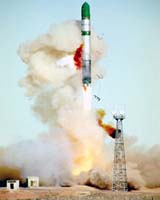
Moscow (RIA Novosti) July 30, 2006 Analysis of the environmental situation at a site in Kazakhstan where a Russian carrier rocket crashed Thursday morning continues while the final results will be announced Monday, the space agency said. The Dnepr carrier rocket crashed shortly after liftoff from the Baikonur space center due to a first stage engine shutdown. The wreckage was discovered at 8:05 Moscow time (4:04 a.m. GMT), 150 kilometers (93 miles) from the space center on a steppe, a long distance from any residential buildings. Igor Panarin, the Federal Space Agency's press secretary, said maximum permissible concentration of noxious substances was only exceeded within a 1 km radius around the crash site. He said earlier a crater at the site of the crash proved that spontaneous ignition had occurred and that combustion products were low toxic. The Dnepr, a civilian version of the heavy R-36M2 Voyevoda (SS-18 Satan) intercontinental ballistic missile, was launched around midnight Wednesday (8 p.m. GMT), and would have orbited 18 Russian and foreign-made mini-satellites. Kazakhstan's presidential representative at Baikonur, Adilbek Basekeyev, said specialists were examining the crash site from helicopters and planes. "There are no casualties, the rocket fell in a deserted place," he said. Kazakh Prime Minister Danial Akhmetov signed a resolution Thursday on forming a government commission to investigate the consequences of the crash. Russia has been using converted ballistic missiles to launch satellites into orbit since 1999. The Dnepr, which was seen as a highly reliable carrier rocket, has a lift-off weight of about 250 metric tons and can carry a satellite payload of up to 3.7 tons to orbits at an altitude of 300-900 kilometers (185-560 miles).
Source: RIA Novosti Community Email This Article Comment On This Article Related Links Rocket Science News at Space-Travel.Com Rocket Science News at Space-Travel.Com
 Findings On GSLV Failure Within A Month Says ISRO Chairman
 Bangalore, India (PTI) Jul 31, 2006
The committee set up to look into the failed mission of GSLV-FO2 was making satisfactory progress and would come out with its findings within a month, ISRO Chairman G Madhavan Nair said here on Friday. |
|
|

| The content herein, unless otherwise known to be public domain, are Copyright 1995-2006 - SpaceDaily.AFP and UPI Wire Stories are copyright Agence France-Presse and United Press International. ESA PortalReports are copyright European Space Agency. All NASA sourced material is public domain. Additionalcopyrights may apply in whole or part to other bona fide parties. Advertising does not imply endorsement,agreement or approval of any opinions, statements or information provided by SpaceDaily on any Web page published or hosted by SpaceDaily. Privacy Statement |