|
 |
 |
 |
 |
 |
 |
 |
 |

 |
Cleaning Event Boosts Power On Opportunity
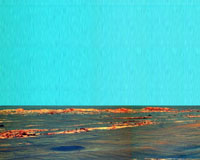
Pasadena CA (SPX) Aug 02, 2006 With only eight Martian days to go before Opportunity joins its twin Spirit in 900-sol territory, the rover has spent its last five sols at a target called Joseph McCoy. At this location, the rover acquired about 41 hours of Mossbauer spectrometer integration, almost seven hours of alpha particle X-ray spectrometer integration, and a mosaic from the microscopic imager. Then Opportunity rolled back, scuffed the soil, and drove 55 meters (180 feet) closer to Beagle Crater. The scuff helps scientists and engineers analyze how the wheels interact with the soil. After the most recent drive, Opportunity is sitting about 25 meters (82 feet) from the rim of Beagle Crater. Over the past 50 sols the team noticed a gradual cleaning of the solar panels similar to a more-sudden cleaning event experienced one Mars-year ago in Endurance Crater. Removal of some of the accumulated dust on the panels allows greater production of electricity from sunlight. Opportunity's solar panels are now producing just over 500 watt-hours per sol. Sol-by-sol summaries: Sol 886 (July 22): Opportunity took microscopic images and an alpha particle X-ray spectrometer reading of the target Joseph McCoy. During the afternoon communication-relay session with NASA's Mars Odyssey orbiter, the rover observed the sky and ground with the miniature thermal emission spectrometer to profile temperatures of the atmosphere and surface. This sol also included a 13-filter panoramic image of a feature called Jesse Chisholm and an abbreviated morning observation of the sky and ground with the miniature thermal emission spectrometer. Sol 887: Opportunity took a Mossbauer reading of Joseph McCoy and a panoramic camera image of Sand Sheet (shot to the south to determine a path to Beagle). In the morning, the rover looked for clouds and made atmospheric measurements. Sol 888: Opportunity continued the Mossbauer examination of Joseph McCoy and conducted a miniature thermal emission spectrometer stare at Jesse Chisholm. The rover checked for clouds and assessed a temperature profile of the atmosphere. Sol 889: The rover restarted the Mossbauer spectrometer, used the miniature thermal emission spectrometer for a seven-point sky and ground observation, and checked for clouds with the navigation camera. Sol 890: Opportunity restarted the Mossbauer spectrometer and did two stares at soil with the miniature thermal emission spectrometer. The rover then stopped the Mossbauer observation and changed tools to the alpha particle X-ray spectrometer before the Odyssey pass. The rover began collecting X-ray spectrometer data on a target called Ignatius. Sol 891: Opportunity rolled back 1.5 meters (5 feet) and scuffed soil with its left-front wheel. The rover then conducted mid-drive imaging, completing a 13-filter panoramic camera image of the robotic arm's work area and the scuff. The rover drove 55 meters (180 feet) toward Beagle Crater. Post-drive imaging included a panoramic camera mosaic and navigation camera image mosaics in the forward and rear directions. Sol 892 (July 28): Opportunity aimed its navigation camera in the direction of the calibration target and take pictures of the sky, checking for clouds. Also, the rover is to use the miniature thermal emission spectrometer to profile near-surface and atmospheric temperatures. Odometry: Opportunity's total odometry as of sol 892 is 8,660.44 meters (5.38 miles). Community Email This Article Comment On This Article Related Links Mars rovers at NASA Lunar Dreams and more
 Arkansas Planetary Science Center To Study Martian Water Chemistry
 Fayetteville AR (SPX) Aug 01, 2006
A recent grant from NASA will enable the Arkansas Center for Space and Planetary Sciences at the University of Arkansas to continue its work creating missions to asteroids and exploring the possibilities and chemistry of water on Mars as part of the nation's space effort. |
|
|

| The content herein, unless otherwise known to be public domain, are Copyright 1995-2006 - SpaceDaily.AFP and UPI Wire Stories are copyright Agence France-Presse and United Press International. ESA PortalReports are copyright European Space Agency. All NASA sourced material is public domain. Additionalcopyrights may apply in whole or part to other bona fide parties. Advertising does not imply endorsement,agreement or approval of any opinions, statements or information provided by SpaceDaily on any Web page published or hosted by SpaceDaily. Privacy Statement |