|
 |
 |
 |
 |
 |
 |
 |
 |

 |
China Has Not Attacked US Satellites Says DoD
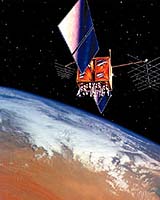
UPI Senior News Analyst Washington (UPI) Oct. 25, 2006 The Pentagon has denied reports that China has tried to blind U.S. satellites with lasers. U.S. Marine Gen. James Cartwright, the head of the U.S. Strategic Command, said in a Sept. 21 interview with "Inside the Pentagon" published on Oct. 12 that the United States had not seen clear indications that China has intentionally disrupted American satellite capabilities, Inside Defense.com reported Oct. 13. Cartwright was quizzed about previously published claims that the Chinese military in recent years had tested systems that could damage or destroy U.S. military satellites in orbit. "Your [question pertains] to someone actually with intent interfering out there," Cartwright said during the Sept. 21 Pentagon interview. "And we really haven't seen that." "You have to expect that any place you put commerce and you put value, there will be competition in that environment," Cartwright said. "The United States relies heavily on satellites for commercial communications, navigation systems and an array of critical military capabilities. The nation owns more than half of the 800 satellites currently in orbit, according to the Union of Concerned Scientists, "InsideDefense.com said. The Web site cited one unnamed U.S. space official as telling it that the U.S. armed forces "rely on space-based commercial communications capacity for up to 80 percent of its needs." Defense News reported on Sept. 21 that China was alleged "to have used a ground-based laser to paint an American satellite," the Center for Defense Information noted in its CDI Space Security Update Monday. CDI Space Security Update cited Donald Kerr, director of the U.S. National Reconnaissance Office (NRO) as confirming "that it happened at least once." The report also noted Gen. Cartwright's response quoted above. "One big problem is that space situational awareness being so poor, it is unclear what the cause is if a satellite were to malfunction," the CDI report said. However, it cited Arms Control Wonk as noting on Sept. 25 that the United States in October 1997 tested a laser against a U.S. satellite at an altitude of 250 miles to determine U.S. vulnerability to such an attack.
Source: United Press International Community Email This Article Comment On This Article Related Links Military Space News at SpaceWar.com Read More About the Chinese Space Program Learn about the Superpowers of the 21st Century at SpaceWar.com The Chinese Space Program - News, Policy and Technology China News from SinoDaily.com
 China Launches Two Space Experiment Satellites
 Taiyuan (XNA) Oct 24, 2006
China successfully launched two satellites for space environment exploration into space with a Long March-4B carrier rocket Tuesday morning. They were launched from the Taiyuan Satellite Launch Center in north China's Shanxi province at 7:34 a.m. Satellite A was detached from the rocket after 11 minutes of take-off, followed by the detachment of Satellite B about one minute later. Both have successfully entered preset orbits. |
|
|

| The content herein, unless otherwise known to be public domain, are Copyright 1995-2006 - SpaceDaily.AFP and UPI Wire Stories are copyright Agence France-Presse and United Press International. ESA PortalReports are copyright European Space Agency. All NASA sourced material is public domain. Additionalcopyrights may apply in whole or part to other bona fide parties. Advertising does not imply endorsement,agreement or approval of any opinions, statements or information provided by SpaceDaily on any Web page published or hosted by SpaceDaily. Privacy Statement |