|
 |
 |
 |
 |
 |
 |
 |
 |

 |
Business Ideas For Space Technology
Paris, France (ESA) Oct 02, 2007 ESA is calling for proposals from entrepreneurs with new ideas on how space technology can be turned into business opportunities in non-space sectors. The deadline for the last round of proposals for this year is 31 October for the Business Incubator at ESTEC, the Netherlands. To date, more than 50 entrepreneurs have been hosted at one of ESA's three Business Incubation centres to start their companies. ESA's support has led to new businesses providing innovative solutions in non-space fields based upon space technology and satellite supplied services.
Business incubation As part of its endeavour to encourage the transfer and commercialisation of space technologies, ESA has set up business incubators at ESTEC in the Netherlands, ESOC in Germany and ESRIN in Italy. The centres support selected entrepreneurs, named 'incubatees', with comprehensive commercial and technical assistance to help them start up business that use space technology in non-space industrial, scientific and commercial fields.
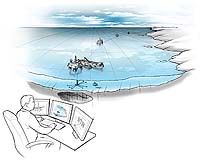
Three start-up successes Roland Haarbrink joined the ESA Business Incubator in 2005 to start his company called Miramap to develop novel solutions for airborne surveys of land and water surface installations over large areas such as water barriers and dykes. The technology, originally developed for satellites, uses passive microwave remote sensing technology. Today Miramap has several clients, including the Dutch Ministry for Traffic and Water Management. After winning the South Holland regional Galileo Masters 2006 competition, Andy Lurling was hosted at ESA's Business Incubator to develop his idea of integrating world car racing into the virtual world of games console racing by using satellite navigation data. "Gamers can participate in the excitement and suspense of a real race and try to beat professional racing drivers and other virtual gamers from their own homes," explains Andy Lurling. His idea turned out to be a great success and today his company iOpener employs seven people and recently won the Ernst and Young Best Business Case Award 2006/2007. End of October iOpener will present their Real-time Games product at a press conference to be held at the Dutch racetrack of Zandfort. Alexandre Van Damme's idea was to use the advanced monitoring concepts and systems used in satellite operation control to monitor oil and gas installations. With the support of ESA's Business Incubator he started the company EATOPS to develop and market a new generation of real-time data monitoring and failure analysis systems called RIVOBS. His system processes the massive amount of data coming from offshore platforms, pipelines and regional production facilities and converts the information into innovative 3-dimensional displays to support operators in their decision making and enable predictive maintenance analysis to become a reality. Community Email This Article Comment On This Article Related Links ESA Business Incubation: Applications The latest information about the Commercial Satellite Industry
 Reflections On Space Progress In The 50 Years Since Sputnik
 Los Angeles CA (SPX) Oct 02, 2007
The space age began 50 years ago this October, when the former Soviet Union launched the first satellite, Sputnik, sparking a U.S.-Soviet space race. Scientists and engineers gathered at the California Institute of Technology Sept. 20 and 21 to talk about space milestones of the past and future exploration. Mike O'Sullivan reports, they say the next 50 years should be even more exiting than the last 50. |
|
|

| The content herein, unless otherwise known to be public domain, are Copyright 1995-2007 - SpaceDaily.AFP and UPI Wire Stories are copyright Agence France-Presse and United Press International. ESA Portal Reports are copyright European Space Agency. All NASA sourced material is public domain. Additional copyrights may apply in whole or part to other bona fide parties. Advertising does not imply endorsement,agreement or approval of any opinions, statements or information provided by SpaceDaily on any Web page published or hosted by SpaceDaily. Privacy Statement |