|
 |
 |
 |
 |
 |
 |
 |
 |

 |
Reflections On Space Progress In The 50 Years Since Sputnik
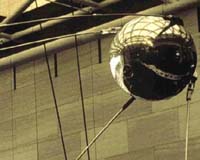
Los Angeles CA (SPX) Oct 02, 2007 The space age began 50 years ago this October, when the former Soviet Union launched the first satellite, Sputnik, sparking a U.S.-Soviet space race. Scientists and engineers gathered at the California Institute of Technology Sept. 20 and 21 to talk about space milestones of the past and future exploration. Mike O'Sullivan reports, they say the next 50 years should be even more exiting than the last 50. Former astronaut Harrison Schmidt recalls how he learned about the beginning of the space age. A geology student on a Fulbright Fellowship, he was living in western Norway with a farming family when he heard the news on shortwave radio. "Every night after they'd gone to bed, I'd go down and listen to the Voice of America and specifically, about 11 o'clock at night, Willis Conover and "Jazz from A to Z" would come on. And the news associated with that program was what brought me the first knowledge that Sputnik had been launched and was successfully orbiting the earth." The following year, the United States launched its own satellite called Explorer and created the U.S. space agency NASA. In 1961, Soviet cosmonaut Yuri Gagarin became the first human in space, followed by the first American, Alan Shepard, Jr. The same year, U.S. President John F. Kennedy promised to put a man on the moon. "I believe that this nation should commit itself to achieving the goal before this decade is out of landing a man on the moon and returning him safely to the earth," Kennedy said. On July 20th, 1969, it happened, as astronaut Neil Armstrong stepped onto the lunar surface saying "That's one small step for man, one giant leap for mankind." Harrison Schmidt would go there himself in December, 1972, on the Apollo 17 mission. He and fellow astronaut Eugene Cernan were the last two people to walk on the moon. Another stream of research was continuing, as unmanned probes explored the solar system. Charles Elachi is director of Jet Propulsion Laboratory, which builds and operates unmanned spacecraft for NASA outside Los Angeles. He is amazed at human accomplishments in just a generation, from landing people on the moon to sending robotic explorers to other planets. "Fifty years ago, we barely knew how to launch something. Fifty years later, we have rovers roving on Mars. We have spacecraft in orbit around Saturn. We have visited every planet in our solar system. We are looking at the origin of the universe, looking at our own planet and able to monitor the changes which are occurring on a daily basis. It's absolutely mind-boggling what was accomplished, and I'm sure over the next 50 years, we are going to accomplish even more," he said. Today, dozens of countries have their own space programs. India's began in the 1960s. Abdul Kalam, who stepped down this year as the nation's president, is an engineer and scientist who is considered the father of India's missile program. He says India puts satellites into orbit for communications, monitoring weather and other terrestrial purposes, and wants to use its orbiting system to link its population of more than one billion. Mr. Kalam tells VOA that space can be an area of cooperation as joint projects bring down costs, and a convergence or synergy of effort speeds up progress. "That will create a kind of synergy, and big changes will come in the space program," he said. Big changes are already happening, says aerospace pioneer Burt Rutan, the man behind the first private rocket in space, SpaceShipOne. Rutan says private sector competition is accelerating the development of technology. Former astronaut Harrison Schmidt says humans have shifted their perspective and opened new options. "We have established ourselves as creatures of the solar system, if we decide to be those creatures. We can live on the moon. We can live on Mars. We know the resources are there to ultimately support settlements independently of any supply from earth," he said. The scientists and engineers who met in California say the moon and planets may one day be a source of energy and natural resources, and will offer insights into the nature of our planet that could help solve problems such as global warming. NASA plans to return humans to the moon by 2020, and officials have announced updated plans for a lunar habitat, including rovers capable of two-week journeys. Former astronaut Schmidt, who served one term in the U.S. Senate, hopes the president and congress will maintain adequate funding to see the program through. Community Email This Article Comment On This Article Related Links The latest information about the Commercial Satellite Industry
 India's space programme wins a European commercial boost
 Hyderabad, India (AFP) Sept 30, 2007
India has won a European vote of confidence as it competes with China to tap a space market expected to generate 145 billion dollars of orders over 10 years, officials say. |
|
|

| The content herein, unless otherwise known to be public domain, are Copyright 1995-2007 - SpaceDaily.AFP and UPI Wire Stories are copyright Agence France-Presse and United Press International. ESA Portal Reports are copyright European Space Agency. All NASA sourced material is public domain. Additional copyrights may apply in whole or part to other bona fide parties. Advertising does not imply endorsement,agreement or approval of any opinions, statements or information provided by SpaceDaily on any Web page published or hosted by SpaceDaily. Privacy Statement |