|
 |
 |
 |
 |
 |
 |
 |
 |

 |
Britain To Publish Plans Next Week On Replacing Nuclear Deterrent
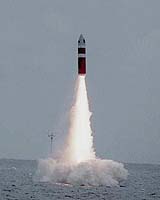
London (AFP) Nov 30, 2006 Plans on the future of Britian's nuclear deterrent missile system will be set out next week and a parliamentary vote will follow next year, Prime Minister Tony Blair's spokesman said Thursday. The government will formally publish its proposals about the ageing Trident weapons system on Monday. Members of the lower House of Commons will then vote on whether to replace it early in the new year, he told reporters. The proposals will be published after a cabinet meeting on Monday. Government members had already been briefed "in detail" by Defence Secretary Des Browne and Foreign Secretary Margaret Beckett, he added. Blair's government is widely expected to give the green light to developing a replacement for the US-built missiles, which are carried on four Royal Navy Vanguard class submarines, one of which is always on patrol. Trident will become obsolete in the mid-2020s. A successor would require many years of development and according to observers could cost up to 25 billion pounds (37 billion euros, 46 billion dollars). Blair and his finance minister Gordon Brown have both indicated that they back the maintenance of an independent nuclear deterrent, despite the costs. But opposition to nuclear weapons and power is historically a central plank of Labour policy and Blair may have a fight on his hands to push through his proposals. Northern Ireland Secretary Peter Hain and International Development Secretary Hilary Benn are reportedly against Trident and about 120 backbench lawmakers from Blair's governing Labour Party have lobbied him to rethink. In the 1980s, Labour leaders like Neil Kinnock spoke at marches organised by the Campaign for Nuclear Disarmament and the issue figured prominently in the party's general election manifestos. Since Blair took over as leader in 1994 and took the left-wing party to the centre ground, however, that position has been reversed. Blair is also in favour of new nuclear power stations to help address Britain's future energy needs.
Source: Agence France-Presse Community Email This Article Comment On This Article Related Links Learn about nuclear weapons doctrine and defense at SpaceWar.com Learn about nuclear weapons doctrine and defense at SpaceWar.com Learn about missile defense at SpaceWar.com All about missiles at SpaceWar.com Learn about the Superpowers of the 21st Century at SpaceWar.com
 North Korean Options
 Washington (UPI) Nov 28, 2006
The North Korean Army with about 1 million active-duty troops is roughly three times the size of the Iraqi Army under Saddam Hussein. A unified Korea would not need such a large armed force on top of the existing 550,000-person South Korean Army. But if the North Korean Army were reduced in size or even disbanded, a large number of trained fighters would suddenly find themselves out of work and desperate to make a living at a time of economic turmoil with few available jobs. |
|
|

| The content herein, unless otherwise known to be public domain, are Copyright 1995-2006 - SpaceDaily.AFP and UPI Wire Stories are copyright Agence France-Presse and United Press International. ESA PortalReports are copyright European Space Agency. All NASA sourced material is public domain. Additionalcopyrights may apply in whole or part to other bona fide parties. Advertising does not imply endorsement,agreement or approval of any opinions, statements or information provided by SpaceDaily on any Web page published or hosted by SpaceDaily. Privacy Statement |