|
 |
 |
 |
 |
 |
 |
 |
 |

 |
Brightest Comet Ever Observed By Soho
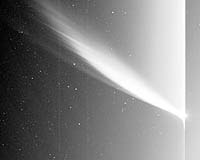
Paris, France (ESA) Jan 17, 2007 Comet C/2006 P1 (McNaught) has become the brightest comet that has been observed by the SOHO instruments since the start of routine operations in early 1996. In its own right, McNaught is the brightest comet observed in the last 40 years. The exact peak apparent magnitude of the comet is not yet determined, but it is currently estimated at -5.5 (see also the related link to the International Comet Quarterly's (ICQ) list of brightest comets). This makes it several magnitudes brighter than SOHO's previously observed brightest comet: C/2002 V1 (NEAT) at about -0.5 magnitude. Comet C/2006 P1 (McNaught) is a single-apparition comet on an hyperbolic orbit, inclined at ~78 to the ecliptic. It was discovered by Rob McNaught on 7 August 2006, when the comet was still at ~3 AU from the Sun, or nearly 450 million km. Over the past 5 months comet McNaught has been steadily closing in on the Sun, eventually passing it at 0.17 AU as it reached perihelion on 12 January 2007. Around perihelion, the comet's proximity to the Sun prevented it from being observable from the ground. SOHO, however, was able to observe the comet during this period. The sequence on the right shows comet C/2006 P1 as it passes the field of view of the LASCO C3 instrument between 12 and 16 January 2007. LASCO (Large Angle and Spectrometric Coronagraph Experiment) is a coronograph dedicated to observing the Sun's corona and uses an occulting disk to block out direct sunlight, covering the central ~2 of the nearly 16 wide view. Also visible in the sequence is Mercury, which is moving slowly from right to left, in the central left part of this view. As the LASCO detector is built to study the much fainter solar corona, the comet appears saturated, with the characteristic horizontal spokes extending from the comet's nucleus. Having passed its perihelion, comet C/2006 P1 (McNaught) is moving away again from the Sun and will become increasingly better visible for ground observers, particularly in the southern hemisphere as its orbit now takes it to higher southern declinations. With the increasing distance to the Sun, however, the comets brightness will decline with time. Community Email This Article Comment On This Article Related Links The Iron and Ice Of Our Solar System Asteroid and Comet Mission News, Science and Technology
 Brightest Comet In 40 Years Dazzles
 Beijing, China (XNA) Jan 16, 2007
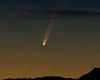
The brightest comet for more than 40 years dazzling the skies in the past week will shine over Australia from Monday, Austrailan astronomers said. The McNaught Comet is currently at its closest approach around the sun and will become visible to West Australians from Monday for about a week. James Biggs, director of the Perth Observatory, said. "It should be easy to locate. Find a vantage point with an unobstructed view and look low on the horizon near where the sun has set, in the direction of south-west, around 9 p.m. (WDT)," Biggs said. |
|
|

| The content herein, unless otherwise known to be public domain, are Copyright 1995-2006 - SpaceDaily.AFP and UPI Wire Stories are copyright Agence France-Presse and United Press International. ESA PortalReports are copyright European Space Agency. All NASA sourced material is public domain. Additionalcopyrights may apply in whole or part to other bona fide parties. Advertising does not imply endorsement,agreement or approval of any opinions, statements or information provided by SpaceDaily on any Web page published or hosted by SpaceDaily. Privacy Statement |