|
 |
 |
 |
 |
 |
 |
 |
 |

 |
Asteroid Flyby In 2029 Still A Concern Warns Russian Astronomer
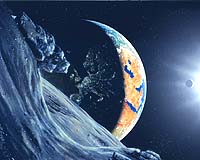
Moscow (RIA Novosti) Oct 03, 2007 An asteroid, discovered in 2004, could pose a threat to Earth in 2029, the director of the Institute of Astronomy said Monday. Boris Shustov said at an international space forum in Moscow that the Apophis asteroid, which is due to cross earth's orbit in 2029 at a height of 27,000 km (17,000 miles), could under certain conditions hit Earth in 2029. The explosion could surpass the famous Tunguska explosion of June 30, 1908, which affected a 2,150 square kilometer (830 sq miles) area of Russia felling over 80 million trees in the Krasnoyarsk Territory in Siberia. The meteoroid's air blast was estimated to be between 10 and 20 megatons in TNT equivalent or 1,000 times more powerful than the atomic bomb dropped on Hiroshima. The explosion caused a shockwave around 5.0 on the Richter scale. However, the asteroid is not likely to repeat the plot of Hollywood blockbusters, as modern technology would allow the asteroid's orbit to be corrected using small satellites, Shustov said. "To blast an asteroid, as some hot shots suggest, is quite an unpredictable step, and a more cautious approach is welcomed now," he said. He said that a microsatellite with 10 liters of fuel could correct the path of the space body.
Source: RIA Novosti Community Email This Article Comment On This Article Related Links Asteroid and Comet Impact Danger To Earth - News and Science
 Thompson Files: To save humanity
 Arlington, Va. (UPI) Sep 25, 2007
 I know how the world ends, and it isn't with a whimper. You can see humanity's epitaph etched in advance by simply gazing up at the moon on any evening and observing the vast craters created by ancient asteroids hitting the lunar surface. (Loren B. Thompson is CEO of the Lexington Institute, an Arlington, Va.-based think tank that supports democracy and the free market.) |
|
|

| The content herein, unless otherwise known to be public domain, are Copyright 1995-2007 - SpaceDaily.AFP and UPI Wire Stories are copyright Agence France-Presse and United Press International. ESA Portal Reports are copyright European Space Agency. All NASA sourced material is public domain. Additional copyrights may apply in whole or part to other bona fide parties. Advertising does not imply endorsement,agreement or approval of any opinions, statements or information provided by SpaceDaily on any Web page published or hosted by SpaceDaily. Privacy Statement |