|
 |
 |
 |
 |
 |
 |
 |
 |

 |
Thompson Files: To save humanity
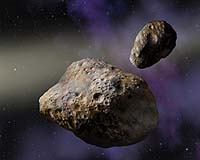
Arlington, Va. (UPI) Sep 25, 2007 I know how the world ends, and it isn't with a whimper. You can see humanity's epitaph etched in advance by simply gazing up at the moon on any evening and observing the vast craters created by ancient asteroids hitting the lunar surface. Earth has suffered many such impacts over its 4.5 billion year history. An extrapolation of lunar data suggests that there have been up to 22,000 asteroid collisions with the Earth creating craters a dozen miles in diameter or bigger. One such impact created the Chesapeake Bay, and someday another will wipe out humanity, assuming some other cataclysm hasn't claimed us first. When a really big asteroid hits, it kills most of the life on Earth by generating a smothering cloud of toxic gases that blots out sunlight for decades. The bigger, more complex species -- like us -- tend to succumb first. An analysis in the Sept. 6 issue of the British science magazine Nature found there was a greater than 90 percent probability one such impact on what is now the Yucatan Peninsula wiped out all the dinosaurs 65 million years ago. The authors speculate that the chain of events triggering the mass extinction actually began 95 million years earlier, before most dinosaurs had even evolved, when two big rocks collided in the asteroid belt between Mars and Jupiter. Once that happened, it was just a matter of time and physics before a fragment fell to Earth, spelling the end of the Cretaceous Period and most of the species it had spawned. Our next close encounter with a major asteroid is expected to occur on April 13, 2029. Friday the 13th, it turns out. At 8:36 a.m. Washington time, a 25 million-ton asteroid will pass within 20,000 miles of the Earth. That isn't just closer than the moon, it's actually closer than the communications satellites we operate in geosynchronous orbit. Should make quite an impression. Unfortunately, there's a small chance that Earth's gravity will perturb the asteroid so that it makes an even bigger impression when we next encounter it seven years later -- by hitting the Earth's surface at 28,000 miles per hour. That wouldn't be the end of the world because the asteroid is only 800 feet across, but it would be a wake-up call about worse impacts to come -- See Popular Mechanics, December 2006. I thought about all this last week, when Aviation Week & Space Technology disclosed that NASA is proposing termination of the space shuttle program six months early, in March of 2010. With only 14 missions remaining for the shuttle fleet, the era of manned space exploration is rapidly winding down for America unless the Bush administration's planned Constellation program stays on track beyond the president's tenure. The Constellation program would produce a new crew exploration vehicle called Orion and family of rockets called Ares to carry astronauts back to the moon, and then eventually on to Mars. It is the only serious plan any nation has for getting human beings to another planet. The official reasons for renewing the human space flight program usually start with scientific research and end with national prestige, but they never mention the fact that humanity will one day be wiped out unless it has found a habitat beyond the Earth. Mars is by far the most congenial candidate, with potential to eventually be "terraformed" into a planet where pressure suits and airtight structures will no longer be needed to sustain human beings. That's a long way off, and it may never happen at the rate our current space efforts are progressing. But whenever you hear about other ways we might spend money set aside for the human space flight program, you ought to think about the big rock that is out there somewhere, destined to destroy everything we have created unless human beings have found another place to live.
Email This Article Comment On This Article Related Links Asteroid and Comet Impact Danger To Earth - News and Science
 First Glimpses From The Perseid Meteor Shower
 Parsis, France (SPX) Aug 16, 2007
Enthusiastic observers were rewarded by a nice display of the Perseid meteor shower that was visible at its best in the night between 12 and 13 August 2007. We present glimpses of the spectacle and the scientific rewards of staying up all night. The comet Swift-Tuttle orbits the Sun with a period of about 130 years. Whenever the comet comes close to the Sun in its orbit, it ejects a stream of dust particles, which are then distributed along its orbit. |
|
|

| The content herein, unless otherwise known to be public domain, are Copyright 1995-2007 - SpaceDaily.AFP and UPI Wire Stories are copyright Agence France-Presse and United Press International. ESA Portal Reports are copyright European Space Agency. All NASA sourced material is public domain. Additional copyrights may apply in whole or part to other bona fide parties. Advertising does not imply endorsement,agreement or approval of any opinions, statements or information provided by SpaceDaily on any Web page published or hosted by SpaceDaily. Privacy Statement |