|
 |
 |
 |
 |
 |
 |
 |
 |

 |
VLT Catches Supernova Between Galaxies
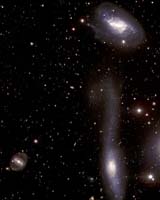
Paranal, Chile (SPX) Jul 13, 2006 Astronomers using ESO's Very Large Telescope have obtained a unique image of a pair of entangled galaxies that includes a supernova well outside the main body of one of the companions. MCG-01-39-003 (bottom right in the above image) is a peculiar spiral galaxy, with a telephone-number name, that presents a hook at one side, probably due to the interaction with its neighbor, the spiral galaxy NGC 5917 (upper right). Further enhancement of the image reveals matter is being pulled off MCG-01-39-003 by NGC 5917. Both galaxies are located at similar distances - about 87-million light-years away - toward the constellation Libra, also known as the Balance. NGC 5917 (also known as Arp 254 and MCG-01-39-002) is about 750 times fainter than can be seen by the unaided eye and about 40,000 light-years across, or 40 percent of the size of the Milky Way. It was discovered in 1835 by William Herschel, who seems to have missed its hooked companion, only 2.5 times fainter. Last year, a star exploded in the vicinity of the hook. The supernova - noted SN 2005cf and the 84th named that year - was discovered by astronomers with the robotic KAIT telescope on May 28. It appeared to be projected on top of a bridge of matter connecting MCG-01-39-003 with NGC5917. Further analysis with the Whipple Observatory 1.5-meter telescope showed the supernova to be a Type Ia, and ejecting material at velocities up to 15,000 kilometers (9,300 miles) per second, or 54-million kilometers (33-million miles) per hour. Immediately after the discovery, the European Supernova Collaboration, led by Wolfgang Hillebrandt of the Max Planck Institute in Garching, Germany, started an extensive observing campaign, using a large number of telescopes around the world. There have been several indications that galaxy encounters and/or galaxy activity phenomena produce enhanced star formation. Therefore, the supernovae in this kind of system are expected to be more frequent than in more isolated galaxies. Normally, this scenario should favor the explosion of young, massive stars. Nevertheless, recent studies have shown such phenomena could increase the number of stars that eventually explode as Type Ia supernovae. The discovery of supernovae in tidal tails connecting interacting galaxies is an exceptional event, and astronomers consider SN 2005cf, appearing close to the tidal bridge between MCG-01-39-002 and MCG-01-39-003, a very interesting case. The ESO team has followed the supernova during its whole evolution, from about 10 days before the object reached its peak luminosity until now, more than a year after the explosion. As the supernova becomes fainter and fainter, astronomers will need larger and larger telescopes to continue to observe it. One year after the explosion, the object already is about 700 times fainter than it appeared at maximum brightness. Observing the later stages is important, because it allows astronomers to probe the ejected material, in order to better understand the explosion mechanism and the elements produced during the explosion. The VLT images reveal a beautiful tidal structure in the form of a hook, with a wealth of details that probably include regions of star formation triggered by the close encounter between the two galaxies. "Curiously, the supernova appears to be outside of the tidal tail," said team leader Ferdinando Patat. "The progenitor system was probably stripped out of one of the two galaxies and exploded far away from the place where it was born." Community Email This Article Comment On This Article Related Links VLT ESO Stellar Chemistry, The Universe And All Within It
 Desert Cosmic Ray Detector Project Moving Ahead
 Salt Lake City UT (SPX) Jun 20, 2006
Construction is accelerating on a $17 million cosmic ray observatory west of Delta, Utah, thanks to two U.S. agencies: the Bureau of Land Management, which issued a permit, and the National Science Foundation, which approved a $2.4 million grant. |
|
|

| The content herein, unless otherwise known to be public domain, are Copyright 1995-2006 - SpaceDaily.AFP and UPI Wire Stories are copyright Agence France-Presse and United Press International. ESA PortalReports are copyright European Space Agency. All NASA sourced material is public domain. Additionalcopyrights may apply in whole or part to other bona fide parties. Advertising does not imply endorsement,agreement or approval of any opinions, statements or information provided by SpaceDaily on any Web page published or hosted by SpaceDaily. Privacy Statement |