|
 |
 |
 |
 |
 |
 |
 |
 |

 |
Desert Cosmic Ray Detector Project Moving Ahead
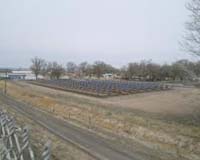
Salt Lake City UT (SPX) Jun 20, 2006 Construction is accelerating on a $17 million cosmic ray observatory west of Delta, Utah, thanks to two U.S. agencies: the Bureau of Land Management, which issued a permit, and the National Science Foundation, which approved a $2.4 million grant. Known as the Telescope Array, the observatory "will be 10 times more sensitive than previous experiments, and we hope it will allow us to finally resolve the mystery of the origin of these ultrahigh-energy particles (cosmic rays) that are bombarding the Earth," said Pierre Sokolsky of the University of Utah. "We'll have the most powerful cosmic ray detector in the Northern Hemisphere," said Charlie Jui (pronounced "Ray"), a physicist at U. Utah. Sokolsky said the new observatory should begin test runs in late spring 2007, start full operation by late summer 2007 and conduct research for up to 10 years. So far, the Telescope Array has been funded by a $14.4 million grant from Japan's government. The three-year NSF grant will permit Utah physicists relocate equipment to the new facility from their aging High-Resolution Fly's Eye cosmic ray observatory on the U.S. Army's Dugway Proving Ground. Structures and roads will occupy only 50 acres of the 400-square-mile experiment site, although the Bureau of Land Management permit allows the use of 374 acres. At three locations on Utah school trust land, buildings will house fluorescence detectors - sets of mirrors and recording instruments that peer into the night sky for faint ultraviolet flashes that occur when incoming cosmic rays hit atoms of nitrogen, the most abundant gas in Earth's atmosphere. Each of the three sites will be about 25 miles from the others. A central laser facility building, located between the three fluorescence detector sites, will send laser beams skyward when the mirrors and recorders need to be calibrated. The other major component of the observatory is a ground array of 564 table-shaped scintillation detectors, each about 3 feet tall and 6-by-10-feet wide. The devices will measure air showers - cascades of subatomic particles that fall to Earth when cosmic rays slam into nitrogen in the atmosphere. The scintillation detectors will be spread in a grid over an 18-mile-by-22-mile area west of Delta. The BLM right-of-way grant/temporary use permit will allow scientists to build the central laser facility and install 460 of the scintillation detectors on BLM land, which covers 80 percent of the observatory site. Permission to install the other 104 scintillation detectors already was obtained from the State of Utah and private landowners. They own the remaining 20 percent of the sprawling site. The new cosmic ray observatory will seek to answer one of the most perplexing mysteries in physics: What is the source of ultrahigh-energy cosmic rays, which are subatomic particles that come screaming into Earth's atmosphere with incredible energy? Cosmic rays are atomic nuclei - atoms stripped of their electrons - of chemical elements, mainly hydrogen and helium. The atmosphere prevents them from hitting Earth, and even if they could, they would zip through a person unnoticed, but if a single ultra-high-energy cosmic ray hit your head, it would feel like a fast-pitched baseball. Some cosmic rays come from stars that explode as supernovae, but ultra-high-energy cosmic rays are more powerful, and apparently come from distant reaches of the universe. Sokolsky said he suspects they originate from active galactic nuclei, which are supermassive black holes formed when about 1 billion collapsed stars amass at the centers of galaxies. Other possible sources include shock waves from colliding galaxies, noisy radio wave-emitting galaxies, exotic sources such as theorized cosmic strings and the decay of massive particles left over from the Big Bang, nearly 14-billion years ago. The Telescope Array will merge two technologies that have counted strikingly different numbers of ultrahigh-energy cosmic rays reaching Earth. Japan's AGASA cosmic ray observatory has detected 10 times more of them than the High-Resolution Fly's Eye. Sokolsky said the large number measured by AGASA implies the source is relatively nearby in the universe, but there are no known astronomical objects that could be the source. So, the Telescope Array will include fluorescence detectors like those used in the High-Resolution Fly's Eye and scintillation detectors like those used at AGASA. "This experiment is unique in the sense that it is the union of two initially competing science groups: a Japanese group and an American group which ran two separate experiments for a decade and came up with mutually incompatible results," Sokolsky said. Community Email This Article Comment On This Article Related Links Telescope Array Stellar Chemistry, The Universe And All Within It
 Integral Sees A GRB Out Of The Corner Of Its Eye
 Paris, France (ESA) Jun 20, 2006
Thanks to a clever piece of design and a sophisticated piece of analysis by European astronomers, Integral - ESA's orbiting gamma-ray observatory - now can take images of the most powerful gamma-ray bursts, even if the spacecraft is aligned in a different direction. Scientists know that once every day or two, a powerful gamma-ray burst will take place somewhere in the universe. |
|
|

| The content herein, unless otherwise known to be public domain, are Copyright 1995-2006 - SpaceDaily.AFP and UPI Wire Stories are copyright Agence France-Presse and United Press International. ESA PortalReports are copyright European Space Agency. All NASA sourced material is public domain. Additionalcopyrights may apply in whole or part to other bona fide parties. Advertising does not imply endorsement,agreement or approval of any opinions, statements or information provided by SpaceDaily on any Web page published or hosted by SpaceDaily. Privacy Statement |