|
 |
 |
 |
 |
 |
 |
 |
 |

 |
US Satellite Successfully Placed In Orbit
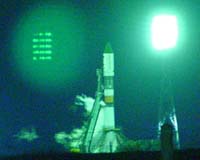
Baikonur, Kazakhstan (AFP) Aug 14, 2005 A Russian Soyuz rocket carrying US telecommunications satellite Galaxy-14 blasted off from Russia's Baikonur space centre in Kazakhstan early Sunday after a 24-hour postponement and successfully placed it in orbit. The blastoff was at 5:28 am (2328 GMT Saturday) and the satellite was placed into geostationary orbit one hour and 37 minutes later. The postponement was decided upon just 30 seconds before the scheduled launch on Saturday due to difficulties in transmitting information about the parameters of the launcher, said Jean-Yves Le Gall, general director of Starsem, the Euro-Russian subsidiary of Arianespace. The two-tonne Galaxy-14 was placed in orbit for American operator PanAmsat. The launch, initially scheduled for August 5, was already put off to enable extra checks to be made on the satellite. Starsem is in charge of selling and exploiting Soyuz on the international market. It is owned by European company Arianespace (15 percent), European aeronautics group EADS (35 percent), Russian federal space agency Roscosmos (25 percent) and Russia's Samara space centre (25 percent). Galaxy-14, built by Orbital Sciences Corporation, will supply services including digital video programs and high-definition television over the whole of the United States. Community Email This Article Comment On This Article Related Links PanAmsat SpaceDaily Search SpaceDaily Subscribe To SpaceDaily Express Launch Pad at Space-Travel.com
 Soyuz To Launch Radarsat-2
 Evry, France (SPX) Jan 11, 2006
Starsem announced Monday the signing of a contract with MacDonald, Dettwiler and Associates (MDA) for the launch of MDA's RADARSAT-2 Earth observation satellite by a Soyuz launch vehicle. |
|
|

| The content herein, unless otherwise known to be public domain, are Copyright 1995-2006 - SpaceDaily.AFP and UPI Wire Stories are copyright Agence France-Presse and United Press International. ESA PortalReports are copyright European Space Agency. All NASA sourced material is public domain. Additionalcopyrights may apply in whole or part to other bona fide parties. Advertising does not imply endorsement,agreement or approval of any opinions, statements or information provided by SpaceDaily on any Web page published or hosted by SpaceDaily. Privacy Statement |