
 |
 |
 |
 |
 |
 |
 |
 |
 |

 |
US Army Facing Cost Crunch Part Three
Washington (UPI) Oct 1, 2008 Today, as it has each year since the mid-1990s, the U.S. Army is seeking to supplement its own budget with "extracurricular" money, mostly in the form of a "wish list" that it sends to Congress each year after an eagerly anticipated congressional request for it. Citing the many problems that it currently faces, ironically the Army seeks the smallest wish list of the military services, $3.9 billion. Instead of seeking a larger "wish list," Army leadership says it seeks larger overall budget requests in future years. The modesty of the $3.9 billion Army "wish list" notwithstanding, taking into account the amount by which the 2009 Army budget already has been increased over and above the extrapolated 2001 plan for 2009, $50.6 billion, it is apparent that the Army actually is seeking a $54.5 billion "wish list plus-up." Of all the major military services, the Army faces the largest burden of the fighting in Iraq and Afghanistan and all the human and material stress that pertains there-from. Appropriately, the Army therefore has received the lion's share of war funding among the services, $387 billion. However, the "plus-up" for the Army's base budget -- $191 billion -- is of the same order of magnitude as the "plus-ups" for the U.S. Air Force and U.S. Navy -- $203 billion and $174 billion, respectively. This would seem to indicate that the basis for each of the services' "plus-ups" is not war-related; instead, the "plus-ups" would seem to be an artifact of the post-Sept. 11, 2001, political environment: In the midst of conflicts -- however unpopular they ultimately may be -- politicians in the executive branch and the U.S. Congress are willing to support a generally rising tide of defense spending. Indeed, the additional spending has not been targeted at any specific service or even specific -- and important -- problem areas, such as shrunken force structure or reduced readiness. In fact, given how the extra money has been applied, it has coincided with the problems growing worse. Given the failure to address problem areas in any meaningful way, the "plus-ups" can only be characterized as a generalized "money heave." When the next president is inaugurated in January 2009, he will face serious problems in the Army and the other military services. These problems will have grown worse than ever before and have done so at a historically high level of spending. Radical changes both in thinking and how money is spent will be needed. The major question is: Will the next president have the force of intellect and, more importantly, character needed to disband business as usual in the Pentagon and Congress and take the first necessary steps for much needed reform? (Winslow T. Wheeler is director of the Straus Military Reform Project at the Center for Defense Information, a Washington-based think tank.) (United Press International's "Outside View" commentaries are written by outside contributors who specialize in a variety of important issues. The views expressed do not necessarily reflect those of United Press International. In the interests of creating an open forum, original submissions are invited.) Community Email This Article Comment On This Article Share This Article With Planet Earth
Related Links The latest in Military Technology for the 21st century at SpaceWar.com
 New Green Warriors To Clean Up The Enemy
 Sn Francisco CA (SPX) Oct 01, 2008
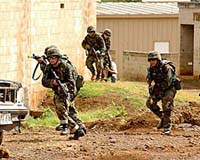
By better managing environmental issues during deployments, U.S. Army units can gain tactical and strategic advantages that will help in combat and post-conflict operations, and boost overall mission success, according to a RAND Corporation study issued today. |
|
|

| The content herein, unless otherwise known to be public domain, are Copyright 1995-2007 - SpaceDaily.AFP and UPI Wire Stories are copyright Agence France-Presse and United Press International. ESA Portal Reports are copyright European Space Agency. All NASA sourced material is public domain. Additional copyrights may apply in whole or part to other bona fide parties. Advertising does not imply endorsement,agreement or approval of any opinions, statements or information provided by SpaceDaily on any Web page published or hosted by SpaceDaily. Privacy Statement |
 del.icio.us
 Digg
Digg Reddit
 YahooMyWeb
 Google
 Facebook