|
 |
 |
 |
 |
 |
 |
 |
 |

 |
UMBC Astronomer Helps Discover Possible New Black Hole
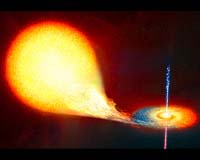
Paris, France (ESA) Nov 30, 2006 An international team of astrophysicists including Volker Beckmann of UMBC/NASA-Goddard has discovered a possible new black hole near the center of the Milky Way galaxy. The previously unknown black hole surprised scientists by suddenly "switching on," emitting strong pulses of radiation as it began consuming gas from the star it orbits over 26,000 light years away from our solar system. The discovery, detailed in a letter published in the journal Astronomy and Astrophysics, was made using NASA and European Space Agency (ESA) satellites. In an ESA press release, Roland Walter, an astronomer at the INTEGRAL Science Data Centre and lead author of the research results, said "The galactic center is one of the most exciting regions for gamma-ray astronomy because there are so many potential gamma-ray sources." Beckmann, a research assistant professor at UMBC's Joint Center for Astrophysics and NASA's Goddard Space Flight Center, was part of the team who used NASA's Swift satellite and ESA's INTEGRAL satellite to spot the tell-tale gamma ray outburst. The research team includes scientists from Switzerland, France, Belgium, Poland, the United States and Spain. According to Beckmann, potential new black holes are scarcer than commonly thought. "We know about 10 stellar systems in which we're pretty sure that there's a black hole involved, and 10 more are good candidates," he said. "What really surprised us was the intensity of the radiation it emitted and how quickly it became an obvious black hole candidate." The team found that the black hole's unusually strong gravitational pull ripped off layers of the star it orbits, drawing them into its maelstrom. "We're not sure why this black hole is letting off occasional bright outbursts of radiation instead of a steady stream," said Beckmann, "But we suspect these powerful emissions are caused by big chunks of the star's matter falling into the black hole." "This detection was possible because of the capability of NASA's Swift satellite to respond quickly to new objects showing up in the sky," said Neil Gehrels, chief of NASA/Goddard's Astroparticle Physics Laboratory and leader of the Swift satellite team. The possible new black hole has drawn the attention of the international astronomy community, having been viewed by all major X-ray telescopes in space including: NASA's Chandra telescope, the Japanese JAXA and NASA collaboration Suzaku and the ESA's XMM-Newton X-ray satellite. Community Email This Article Comment On This Article Related Links INTEGRAL Science Data Centre Stellar Chemistry, The Universe And All Within It Understanding Time and Space
 Integral Catches A New Erupting Black Hole
 Paris, France (ESA) Nov 28, 2006
ESA's gamma-ray observatory, Integral, has spotted a rare kind of gamma-ray outburst. The vast explosion of energy allowed astronomers to pinpoint a possible black hole in our Galaxy. The outburst was discovered on 17 September 2006 by staff at the Integral Science Data Centre (ISDC), Versoix, Switzerland. Inside the ISDC, astronomers constantly monitor the data coming down from Integral because they know the sky at gamma-ray wavelengths can be a swiftly changing place. |
|
|

| The content herein, unless otherwise known to be public domain, are Copyright 1995-2006 - SpaceDaily.AFP and UPI Wire Stories are copyright Agence France-Presse and United Press International. ESA PortalReports are copyright European Space Agency. All NASA sourced material is public domain. Additionalcopyrights may apply in whole or part to other bona fide parties. Advertising does not imply endorsement,agreement or approval of any opinions, statements or information provided by SpaceDaily on any Web page published or hosted by SpaceDaily. Privacy Statement |