|
 |
 |
 |
 |
 |
 |
 |
 |

 |
Twin space probe design phase begins
Laurel, Md., April 21, 2008 The U.S. space agency said design has started on its radiation storm probes -- twin spacecraft that will be launched into the Earth's radiation belts. Researchers said the National Aeronautics and Space Administration spacecraft are being designed to provide insight into the physical dynamics of near-Earth space, where violent space weather can affect astronauts, satellites and even ground-based technologies. Researchers and engineers at the Johns Hopkins University Applied Physics Laboratory in Laurel, Md., will build and operate the twin probes, which are scheduled for a 2011 launch and a primary mission of two years. The radiation belts are two doughnut-shaped regions encircling Earth, where high-energy particles are trapped by the planet's magnetic field, scientists said. Most Earth-orbiting spacecraft pass through the belts, which can affect both astronauts and spacecraft. Scientists hope the space mission will resolve decades-old scientific mysteries of how such particles become energized to such high levels and how the radiation belts vary so dramatically with changing conditions on the sun. The instruments will be provided by teams managed by Boston University, the University of Iowa, the University of Minnesota, the New Jersey Institute of Technology and the National Reconnaissance Office. Community Email This Article Comment On This Article Related Links Space Technology News - Applications and Research
 Communication From Car To Car - DLR Brings Mobile Communications Network Into Operation
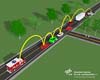 Cologne, Germany (SPX) Apr 14, 2008
A new mobile communications network between vehicles (car-to-car, or C2C for short) has been brought into operation at the German Aerospace Center (DLR) Oberpfaffenhofen site. Scientists are using it to find out to what extent specially-equipped vehicles can 'inform' each other of their relative positions, state, and the traffic situation. The aim is totally new applications, leading to increased road safety and traffic-flow efficiency. |
|
|

| The content herein, unless otherwise known to be public domain, are Copyright 1995-2007 - SpaceDaily.AFP and UPI Wire Stories are copyright Agence France-Presse and United Press International. ESA Portal Reports are copyright European Space Agency. All NASA sourced material is public domain. Additional copyrights may apply in whole or part to other bona fide parties. Advertising does not imply endorsement,agreement or approval of any opinions, statements or information provided by SpaceDaily on any Web page published or hosted by SpaceDaily. Privacy Statement |