|
 |
 |
 |
 |
 |
 |
 |
 |

 |
Twenty-Two Projects Keep Supercomputer Super Busy
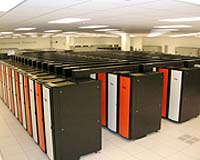
Oak Ridge TN (SPX) Nov 01, 2006 With 54 teraflops of computing power, Oak Ridge National Laboratory's Cray XT3 is helping solve scientific grand challenges, but scheduling the many research projects and keeping the massive machine operating at peak capacity are challenges of their own. The Cray, known as Jaguar, requires a complex infrastructure that can cool more than 5,000 dual-core processors; ensure reliable power; maintain optimum operation; and accommodate future expansion. The facilities at ORNL are among the few in the world that meet these and other demanding criteria required for computer simulations at this scale in chemistry, combustion, astrophysics, biology, fusion, climate and physics. Big science and the accompanying big applications that make the best use of the machine receive priority. In fact, ORNL frequently has a single project that uses all of the processors for up to 24 hours. The constant goal is to make the most of the computing resource. "We have people and programs to ensure that we're utilizing the computer as efficiently as possible," said Doug Kothe, director of science for the National Center for Computational Sciences. "That's part of our duty and responsibility to the taxpayers who support this leadership-class open resource." Built in to the design of Jaguar is the ability to detect and compensate for failures likely to occur in such a complex system. ORNL and Cray have people dedicated full time to keeping the machine operating. Allocations of computing time (processor hours) for research projects are made under the U.S. Department of Energy's Innovative and Novel Computational Theory and Experiment program. Coordinated by DOE's Office of Science, INCITE is open to all scientific researchers and research organizations, including industry. The program is intended for computationally intensive research projects of large scale that can make high-impact scientific advances through the use of a large allocation of computer time, resources and data storage. Proposals are for projects that run for one to three years. In the first phase of the INCITE awards process, proposals undergo a technical readiness review. "We look at how the applications will utilize the capabilities of the Leadership Computing Facility supercomputing resources and make recommendations based on the scalability and performance of those applications," said Ricky Kendall, group leader for the Scientific Computing Group at the Center for Computational Sciences. The technical readiness review team consists of scientists with diverse backgrounds and expertise in computational science. In the second phase, DOE convenes a panel that reviews all aspects of the proposals for general scientific merit and comparisons are made across scientific disciplines. Proposals for 2007 awards were due in September. The panel will make recommendations to DOE, which will announce the awards in December. Last year's call for INCITE proposals resulted in 43 submissions requesting more than 95 million processor hours. The proposals covered 11 scientific disciplines: accelerator physics, astrophysics, chemical sciences, climate research, computer science, engineering physics, environmental science, fusion energy, life sciences, materials sciences and nuclear physics. A total of 18.2 million processor hours were awarded for 2006 INCITE and Leadership Computing Facility projects. Eighty percent of the Cray leadership-class computers - Jaguar and Phoenix -- at ORNL are available to INCITE. Counting allocation awards from previous years, some 30 million processor hours are being run this year on ORNL's Jaguar and another nearly 6 million are being run on ORNL's Phoenix, a Cray X1E with 18.5 teraflops. The remaining allocations of computing time for this year were made for computers at Lawrence Berkeley, Argonne and Pacific Northwest national laboratories. The largest Leadership Computing Facility project allocation at ORNL involves multidimensional simulations of core-collapse supernovae and consumes 3.55 million processor hours on Jaguar. The goal is to understand how stars more massive than 10 of our suns explode to produce many of the elements in the universe, like oxygen and iron, necessary for life. The lead researcher is Tony Mezzacappa of ORNL's Physics Division. Next in line for processor hours with 3.5 million hours on Jaguar and 300,000 hours on Phoenix is a nano- and materials sciences project headed by Thomas Schulthess of the Computer Science and Mathematics Division and the Center for Nanophase Materials Sciences. The project is aimed at a better understanding of complex functional nanostructures, which could lead to more much faster and more energy efficient electronic devices, and better materials for energy storage, transmission and production. A turbulent combustion project headed by Sandia's Jacqueline Chen is allocated 3 million Jaguar hours and 600,000 processor hours on Phoenix, and Don Batchelor of ORNL's Fusion Energy Division leads a wave-plasma simulation project also awarded 3 million processor hours on Jaguar. Batchelor's work could ultimately help solve one of the obstacles to making fusion a reality. Other users include Dreamworks Animation, The Boeing Company, General Atomics, Harvard University, Auburn University and the University of Washington/Howard Hughes Medical Institute. The Jaguar is scheduled to be upgraded to 100 teraflops (100 trillion mathematical calculations per second) by the end of this year. ORNL is managed by UT-Battelle for the Department of Energy. Community Email This Article Comment On This Article Related Links Oak Ridge National Laboratory INCITE Space Technology News - Applications and Research
 Scientists Build Space Age Space Computer
 Gainesville FL (SPX) Oct 31, 2006
U.S. scientists say they are developing a space computer that will operate as much as 100 times faster than any computer in space today. Engineering researchers at the University of Florida and Honeywell Aerospace are designing and building the computer that's needed to process the rapidly increasing amounts of data being gathered by orbiting satellites. |
|
|

| The content herein, unless otherwise known to be public domain, are Copyright 1995-2006 - SpaceDaily.AFP and UPI Wire Stories are copyright Agence France-Presse and United Press International. ESA PortalReports are copyright European Space Agency. All NASA sourced material is public domain. Additionalcopyrights may apply in whole or part to other bona fide parties. Advertising does not imply endorsement,agreement or approval of any opinions, statements or information provided by SpaceDaily on any Web page published or hosted by SpaceDaily. Privacy Statement |