|
 |
 |
 |
 |
 |
 |
 |
 |

 |
Turning An Axel Mounted Molecular Wheel
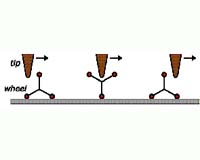
Toulouse, France (SPX) Jan 24, 2007 Researchers at the Centre for Material Development and Structural Studies in Toulouse (CEMES-CNRS) and their colleagues at the Free University of Berlin have, for the first time, managed to control the rotation of a wheel in a molecule. This nano-mechanical experiment concerned an 0.7 nm diameter wheel attached to a 0.6 nm-long axle. This success opens the way to creating the first molecular machines. The study was published on-line on January 21, 2007, in the journal Nature Nanotechnology. In the history of inventions, the wheel has been at the origin of major scientific and technological developments: from the creation of astronomical clocks or calculating machines to motor-drawn vehicles and other motor cars. At the molecular scale, the smallest at which a wheel can be created, it represents a major challenge for chemists and physicists. Since the end of the 1990s, chemists in the CEMES have been working on the design of molecular machines equipped with wheels. Step by step, they have studied this field in depth in collaboration with their colleagues at IBM in Zurich and then at the Free University of Berlin. After observing the random rotation of a flat molecular wheel in 1998, designing and synthesising a mono-molecular wheelbarrow in 2003 and then synthesising a molecular motor in 2005, they last year managed to operate the first molecular rack with a pinion of 1.2 nm in diameter. Today, these researchers have shown that a molecular wheel mounted on an axle (as short as possible) could rotate. They have succeeded in controlling its direction of rotation. To prepare this nano-mechanical experiment, the CEMES-CNRS chemists designed and synthesised simple molecular machinery made up of an 0.6 nm-long axle-molecule, bound chemically with two triptycene wheels with a diameter of around 0.7 nm (Figure 1). The type of wheel and surface were very carefully chosen. Two notched, "tyre-less" wheels were used because of their maximum adherence to the running surface, an ultraclean copper plate. Its natural roughness presented rows of copper atoms separated by a distance of about 0.3 nm, and about one atom high. The experiment consisted in delicately placing wheel-axle-wheel molecules on the copper surface and then using scanning tunnelling microscopy (STM) imaging at very low temperature to detect molecules lying in the correct orientation with respect to the rows of atoms on the surface. The STM tip positioned on a wheel made the latter rotate. By advancing the STM tip, the microscope behaved like a finger to trigger the rotation. Fig. 2. Movement of the STM probe on a wheel inducing a rotation of 120�. The STM operator followed real-time on his control screen any variations in electrical current passing through the wheel while he was rolling it. Depending on the handling conditions of the molecule, he could choose to turn one wheel and then the other while the molecule advanced, or make the molecule advance without rolling its wheels. This experiment enabled an approach to understanding at the mono-molecular scale the functionalities that are already known at a macroscopic scale. Without a wheel, some technological advances could not function. For example, separating the seating or technical parts of a vehicle is essential to prevent friction. At a molecular scale, the reasoning and consequences are similar. If the plate of the molecule is not separated from the surface, there is interaction and hence destruction. These results open the way to creating molecular machines. A goal? To be able, one day, to embark in a single molecule the entire machinery of a nano-vehicle: four wheels, a motor, etc. Rolling a single molecular wheel at the atomic scale: Leo Grill, Karl Heinz Rieder, Francesca Moresco, Gwenael Rapenne, Sladjana M. Stojkovic, Xavier Bouju, Christian Joachim, Nature Nanotechnology, February 2007, on-line on January 21, 2007. Community Email This Article Comment On This Article Related Links CNRS Nano Technology News From SpaceMart.com All about the technology of space and more Nano Technology News From SpaceMart.com Computer Chip Architecture, Technology and Manufacture
 Delft Nano-Detector Very Promising For Remote Cosmic Realms
 Delft, Holland (SPX) Jan 18, 2007
A miniscule but super-sensitive sensor can help solve the mysteries of outer space. Cosmic radiation, which contains the terahertz frequencies that the sensors detect, offers astronomers important new information about the birth of star systems and planets. |
|
|

| The content herein, unless otherwise known to be public domain, are Copyright 1995-2006 - SpaceDaily.AFP and UPI Wire Stories are copyright Agence France-Presse and United Press International. ESA PortalReports are copyright European Space Agency. All NASA sourced material is public domain. Additionalcopyrights may apply in whole or part to other bona fide parties. Advertising does not imply endorsement,agreement or approval of any opinions, statements or information provided by SpaceDaily on any Web page published or hosted by SpaceDaily. Privacy Statement |