|
 |
 |
 |
 |
 |
 |
 |
 |

 |
Delft Nano-Detector Very Promising For Remote Cosmic Realms
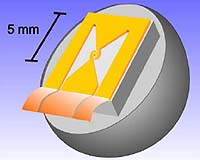
Delft, Holland (SPX) Jan 18, 2007 A miniscule but super-sensitive sensor can help solve the mysteries of outer space. Cosmic radiation, which contains the terahertz frequencies that the sensors detect, offers astronomers important new information about the birth of star systems and planets. Merlijn Hajenius developed these sensors for Delft University of Technology's Kavli Institute of Nanoscience, in close cooperation with the SRON Netherlands Institute for Space Research. He will receive his Delft University of Technology PhD degree on 19 January based on this research subject. The detector, called a 'hot electron bolometer', is based on the well-known phenomenon that electrical resistance increases when something is heated up. The use of a superconductor renders the detector extremely sensitive and allows it to be used for radiation that until now could not be so well detected. The detector works for terahertz frequencies, which astronomers and atmospheric scientists are extremely interested in. The detector's core is comprised of a small piece of superconducting niobiumnitride. Clean superconducting contacts that are kept at a constant temperature of -268 C (five degrees above absolute zero) are attached to both ends of the superconducting niobiumnitride. A miniscule gold antenna catches the terahertz-radiation and sends it via the contacts to the small piece of niobiumnitride, which functions as an extremely sensitive thermometer. "By reading this thermometer, we can very accurately measure the terahertz radiation. In Delft, we have set a world record with this detector in the frequency area above 1.5 terahertz," Hajenius says proudly. The results have convinced astronomers to use these detectors for the new observatory in Antarctica (HEAT), and a new space mission (ESPRIT) has also been proposed. The 'maiden flight' of Hajenius' detector is planned for next year, but it will not take place in a satellite used for studying cosmic clouds, but rather in a balloon that will study the earth's atmosphere. The TELIS instrument, which SRON is currently working on, will be equipped with a Delft University of Technology detector and will measure the molecules in the atmosphere above Brazil that influence the formation of the hole in the ozone layer. Community Email This Article Comment On This Article Related Links Delft University of Technology SRON Netherlands Institute for Space Research Nano Technology News From SpaceMart.com Nano Technology News From SpaceMart.com Computer Chip Architecture, Technology and Manufacture
 Nano-particles Could Strangle Cancer Cells
 Washington (UPI) Jan 09, 2007
Researchers said Tuesday they have developed tiny nano-particles that can home in on tumors, making the cancer more visible to doctors while also clogging the tumors and hindering their growth. Animal studies have demonstrated that the nano-particles can choke off as much as 20 percent of the tumor's blood supply, said Erkki Ruoslahti, professor of medicine at the Burnham Institute for Medical Research at the University of California in Santa Barbara. |
|
|

| The content herein, unless otherwise known to be public domain, are Copyright 1995-2006 - SpaceDaily.AFP and UPI Wire Stories are copyright Agence France-Presse and United Press International. ESA PortalReports are copyright European Space Agency. All NASA sourced material is public domain. Additionalcopyrights may apply in whole or part to other bona fide parties. Advertising does not imply endorsement,agreement or approval of any opinions, statements or information provided by SpaceDaily on any Web page published or hosted by SpaceDaily. Privacy Statement |