|
 |
 |
 |
 |
 |
 |
 |
 |

 |
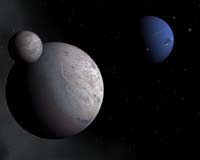
Trio Of Neptunes And Their Belt
La Silla, Chile (SPX) May 18, 2006 Using the ultra-precise HARPS spectrograph on ESO's 3.6-m telescope at La Silla (Chile), a team of European astronomers have discovered that a nearby star is host to three Neptune-mass planets. The innermost planet is most probably rocky, while the outermost is the first known Neptune-mass planet to reside in the habitable zone. This unique system is likely further enriched by an asteroid belt. "For the first time, we have discovered a planetary system composed of several Neptune-mass planets", said Christophe Lovis, from the Geneva Observatory and lead-author of the paper presenting the results [1]. During more than two years, the astronomers carefully studied HD 69830, a rather inconspicuous nearby star slightly less massive than the Sun. Located 41 light-years away towards the constellation of Puppis (the Stern), it is, with a visual magnitude of 5.95, just visible with the unaided eye. The astronomers' precise radial-velocity measurements [2] allowed them to discover the presence of three tiny companions orbiting their parent star in 8.67, 31.6 and 197 days. "Only ESO's HARPS instrument installed at the La Silla Observatory, Chile, made it possible to uncover these planets", said Michel Mayor, also from Geneva Observatory, and HARPS Principal Investigator. "Without any doubt, it is presently the world's most precise planet-hunting machine" [3]. The detected velocity variations are between 2 and 3 metres per second, corresponding to about 9 km/h! That's the speed of a person walking briskly. Such tiny signals could not have been distinguished from 'simple noise' by most of today's available spectrographs. The newly found planets have minimum masses between 10 and 18 times the mass of the Earth. Extensive theoretical simulations favour an essentially rocky composition for the inner planet, and a rocky/gas structure for the middle one. The outer planet has probably accreted some ice during its formation, and is likely to be made of a rocky/icy core surrounded by a quite massive envelope. Further calculations have also shown that the system is in a dynamically stable configuration. The outer planet also appears to be located near the inner edge of the habitable zone, where liquid water can exist at the surface of rocky/icy bodies. Although this planet is probably not Earth-like due to its heavy mass, its discovery opens the way to exciting perspectives. "This alone makes this system already exceptional", said Willy Benz, from Bern University, and co-author. "But the recent discovery by the Spitzer Space Telescope that the star most likely hosts an asteroid belt is adding the cherry to the cake." With three roughly equal-mass planets, one being in the habitable zone, and an asteroid belt, this planetary system shares many properties with our own solar system. "The planetary system around HD 69830 clearly represents a Rosetta stone in our understanding of how planets form", said Michel Mayor. "No doubt it will help us better understand the huge diversity we have observed since the first extra-solar planet was found 11 years ago." High resolution images and their captions are available on this page. Video footage and animations are also available on this page. Community Email This Article Comment On This Article Related Links The million outer planets of a star called Sol
 New Model Could Explain Eccentric Triton Orbit
 Santa Cruz CA (SPX) May 12, 2006
Triton may have abandoned an earlier partner to arrive in its unusual orbit around Neptune, researchers said Wednesday. Triton is unique among all large moons in the solar system because it follows a retrograde orbit around Neptune - opposite to the planet's rotation. |
|
|

| The content herein, unless otherwise known to be public domain, are Copyright 1995-2006 - SpaceDaily.AFP and UPI Wire Stories are copyright Agence France-Presse and United Press International. ESA PortalReports are copyright European Space Agency. All NASA sourced material is public domain. Additionalcopyrights may apply in whole or part to other bona fide parties. Advertising does not imply endorsement,agreement or approval of any opinions, statements or information provided by SpaceDaily on any Web page published or hosted by SpaceDaily. Privacy Statement |