|
 |
 |
 |
 |
 |
 |
 |
 |

 |
New Model Could Explain Eccentric Triton Orbit
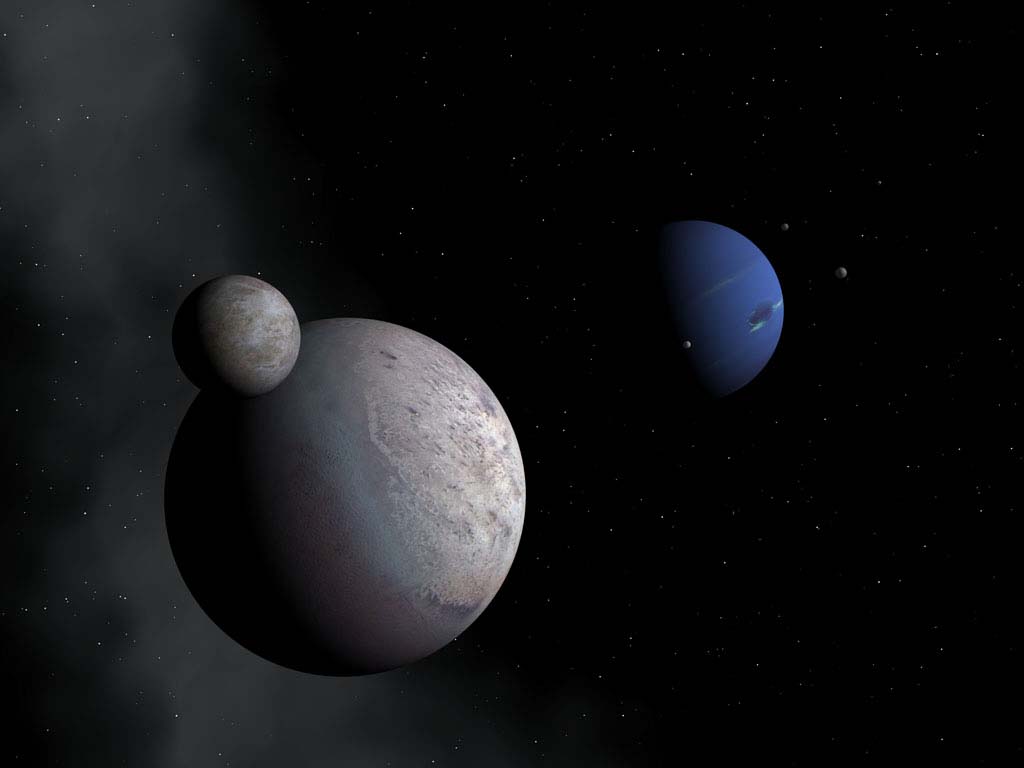
Santa Cruz CA (SPX) May 12, 2006 Triton may have abandoned an earlier partner to arrive in its unusual orbit around Neptune, researchers said Wednesday. Triton is unique among all large moons in the solar system because it follows a retrograde orbit around Neptune - opposite to the planet's rotation. Most astronomers think Triton is unlikely to have adopted its orbital path naturally and more likely was captured from elsewhere. Reporting in the May 11 issue of Nature, planetary scientists Craig Agnor of the University of California, Santa Cruz, and Douglas Hamilton of the University of Maryland in College Park said they have created a computer model that mimics the capture of moons involving a three-body gravitational encounter between a binary and a planet. The scenario, they said, could explain how Triton once was a member of a binary pair of objects orbiting the Sun and each other. Then, gravitational interactions during a close encounter with Neptune pulled Triton away from its companion and locked it in retrograde orbit around the gas giant. "We've found a likely solution to the long-standing problem of how Triton arrived in its peculiar orbit, Agnor said. "In addition, this mechanism introduces a new pathway for the capture of satellites by planets that may be relevant to other objects in the solar system." With properties similar to Pluto and about 40 percent more massive, Triton follows an inclined circular orbit that takes it between a group of small inner moons with conventional orbits and an outer group of small satellites with both prograde and retrograde orbits. The solar system has other retrograde moons, including some small outer satellites of Jupiter and Saturn, but all are tiny compared to Triton - less than a few thousandths of its mass - and follow much larger and more eccentric orbits. Agnor said Triton may have originated in a binary system similar to Pluto and Charon, which is relatively massive, at about one-eighth the size of Pluto. "It's not so much that Charon orbits Pluto, but rather both move around their mutual center of mass, which lies between the two objects," Agnor said. In a close encounter with a giant planet such as Neptune, the planet's gravitational forces could have pulled apart the binaries. Their orbital motion usually causes one member to move more slowly than the other, and disruption of the binary leaves both members with residual motions that can result in a permanent change of orbital companions. This mechanism, known as an exchange reaction, could have delivered Triton to a variety of different orbits around Neptune, Agnor said. An earlier scenario proposed for Triton was it could have collided with another Neptunian satellite, but this mechanism required the object involved in the collision to be large enough to slow Triton down, yet small enough not to destroy it. Agnor said he considers the probability of such a collision extremely small. Another suggestion involves the effect of aerodynamic drag from a disk of gas around Neptune, which slowed Triton down enough for it to be captured. The problem is the scenario constrains the timing of the capture event. It would have had to occur early in Neptune's history when the planet was surrounded by a gas disk, but late enough for the gas to disperse before it slowed Triton's orbit enough to send the moon crashing into the planet. In the past decade, many binaries have been discovered in the Kuiper belt and elsewhere in the solar system. Recent surveys indicate about 11 percent of Kuiper belt objects are binaries, as are about 16 percent of near-Earth asteroids. "These discoveries pointed the way to our new explanation of Triton's capture," Hamilton said. "Binaries appear to be a ubiquitous feature of small-body populations." The Pluto-Charon pair and binaries in the Kuiper belt are especially relevant for Triton, as their orbits abut Neptune's, he said. "Similar objects have probably been around for billions of years, and their prevalence indicates that the binary-planet encounter that we propose for Triton's capture is not particularly restrictive," Hamilton added. The scenario described by Agnor and Hamilton might have broad applications in understanding the evolution of the solar system, which contains many irregular satellites. The scientists said they plan to explore the implications of their findings for other satellite systems. Their research was supported by grants from NASA's Planetary Geology and Geophysics, Outer Planet Research, and Origins of Solar Systems programs. Community Email This Article Comment On This Article Related Links - The million outer planets of a star called Sol
 New Horizons Taking Exploration To Edge Of Sol
 Boulder CO (SPX) May 02, 2006
Our spaceship, New Horizons, was paid for by the people of the United States of America. New Horizons is on its way to the very frontier of our solar system: Pluto and the Kuiper Belt. Great nations explore. |
|
|

| The content herein, unless otherwise known to be public domain, are Copyright 1995-2006 - SpaceDaily.AFP and UPI Wire Stories are copyright Agence France-Presse and United Press International. ESA PortalReports are copyright European Space Agency. All NASA sourced material is public domain. Additionalcopyrights may apply in whole or part to other bona fide parties. Advertising does not imply endorsement,agreement or approval of any opinions, statements or information provided by SpaceDaily on any Web page published or hosted by SpaceDaily. Privacy Statement |