|
 |
 |
 |
 |
 |
 |
 |
 |

 |
"Trapped rainbow" could herald new dawn for computing
Paris (AFP) Nov 14, 2007 Scientists in Britain said Wednesday they were able to slow and then stop a squirt of light in what they described as a key step towards the future of ultra-fast computing. The technique, called "trapped rainbow," would help optical data storage, with light replacing electrons to store information, according to their paper, released by the British science journal Nature. Controlling light would also help engineers control major nodes where billions of optical data "packets" arrive at the same time. By slowing some packets to let others through, rather like a traffic congestion scheme, the flow of data can be boosted. The research, by Ortwin Hess, a professor at the University of Surrey at Guildford, southern England and postgraduate student Kosmas Tsakmakidis, is based on the so-called "negative refractive index" of metamaterials. Metamaterials are novel materials with metal components that are smaller than the wavelength of light, while the refractive index measures the slowing of light when it passes through an object. The innovation exploits a principle called the Goos-Haenchen effect, an optical phenomenon discovered 60 years ago that happens to polarised light travelling in a straight line. When this light hits an object or an interface between two media, it does not immediately bounce back but travels very slightly along that object. In the case of metamaterials, the light in fact travels very slight backwards along the object. Hess conjectured creating a prism "sandwich" -- a tapered layer of glass, surrounded by two layers of negative refractive index metamaterials. A packet of white light injected into the glass from the wide end of the prism slows as it travels down the taper and eventually comes to a standstill. The description of it as a "trapped rainbow" derives from the fact that the constituent frequencies of white light are the colours of the rainbow -- red, orange, yellow, green, blue, indigo and violet. Each individual frequency is stopped at a different point down the taper, until finally the light is stopped. "It's like wading through snow, it gets more and more sluggish," Hess told AFP in an interview. Eventually, "it just sits there and gets trapped." In a press release, the University of Surrey said that by exploiting the different frequencies that comprise the light spectrum and by slowing, stopping and capturing these frequences, the way was open for a massive boost in data handling. "The technique would allow the use of light rather than electrons to store memory in devices such as computers, enabling an increase in operating capacity of 1,000 percent," it claimed. "Previous attempts to slow and capture light have involved extremely low or cryogenic temperatures, have been extremely costly and have only worked with one specific frequency of light at a time," the university noted. Community Email This Article Comment On This Article Related Links Computer Chip Architecture, Technology and Manufacture Nano Technology News From SpaceMart.com
 Micro Microwave Does Pinpoint Cooking For Miniaturized Labs
 Washington DC (SPX) Nov 12, 2007
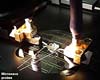
Researchers at the National Institute of Standards of Technology (NIST) and George Mason University have demonstrated what is probably the world's smallest microwave oven, a tiny mechanism that can heat a pinhead-sized drop of liquid inside a container slightly shorter than an ant and half as wide as a single hair. The micro microwave is intended for lab-on-a-chip devices that perform rapid, complex chemical analyses on tiny samples. |
|
|

| The content herein, unless otherwise known to be public domain, are Copyright 1995-2007 - SpaceDaily.AFP and UPI Wire Stories are copyright Agence France-Presse and United Press International. ESA Portal Reports are copyright European Space Agency. All NASA sourced material is public domain. Additional copyrights may apply in whole or part to other bona fide parties. Advertising does not imply endorsement,agreement or approval of any opinions, statements or information provided by SpaceDaily on any Web page published or hosted by SpaceDaily. Privacy Statement |