|
 |
 |
 |
 |
 |
 |
 |
 |

 |
Micro Microwave Does Pinpoint Cooking For Miniaturized Labs
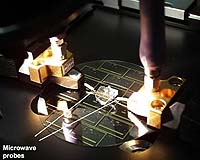
Washington DC (SPX) Nov 12, 2007 Researchers at the National Institute of Standards of Technology (NIST) and George Mason University have demonstrated what is probably the world's smallest microwave oven, a tiny mechanism that can heat a pinhead-sized drop of liquid inside a container slightly shorter than an ant and half as wide as a single hair. The micro microwave is intended for lab-on-a-chip devices that perform rapid, complex chemical analyses on tiny samples. In a paper in the November 2007 Journal of Micromechanics and Microengineering*, the research team led by NIST engineer Michael Gaitan describes for the first time how a tiny dielectric microwave heater can be successfully integrated with a microfluidic channel to control selectively and precisely the temperature of fluid volumes ranging from a few microliters (millionth of a liter) to sub-nanoliters (less than a billionth of a liter). Sample heating is an essential step in a wide range of analytic techniques that could be built into microfluidic devices, including the high-efficiency polymerase chain reaction (PCR) process that rapidly amplifies tiny samples of DNA for forensic work, and and methods to break cells open to release their contents for study. The team embedded a thin-film microwave transmission line between a glass substrate and a polymer block to create its micro microwave oven. A trapezoidal-shaped cut in the polymer block only 7 micrometers across at its narrowest-the diameter of a red blood cell-and nearly 4 millimeters long (approximately the length of an ant) serves as the chamber for the fluid to be heated. Based on classical theory of how microwave energy is absorbed by fluids, the research team developed a model to explain how their minature oven would work. They predicted that electromagnetic fields localized in the gap would directly heat the fluid in a selected portion of the micro channel while leaving the surrounding area unaffected. Measurements of the microwaves produced by the system and their effect on the fluid temperature in the micro channel validated the model by showing that the increase in temperature of the fluid was predominantly due to the absorbed microwave power. Once the new technology is more refined, the researchers hope to use it to design a microfluidic microwave heater that can cycle temperatures rapidly and efficiently for a host of applications. Community Email This Article Comment On This Article Related Links National Institute of Standards and Technology (NIST) Computer Chip Architecture, Technology and Manufacture Nano Technology News From SpaceMart.com
 New Computer Program Automates Chip Debugging
 Ann Arbor MI (SPX) Nov 06, 2007
Fixing design bugs and wrong wire connections in computer chips after they've been fabricated in silicon is a tedious, trial-and-error process that often costs companies millions of dollars and months of time-to-market. Engineering researchers at the University of Michigan say it doesn't have to be that way. They've developed a new technology to automate "post-silicon debugging." |
|
|

| The content herein, unless otherwise known to be public domain, are Copyright 1995-2007 - SpaceDaily.AFP and UPI Wire Stories are copyright Agence France-Presse and United Press International. ESA Portal Reports are copyright European Space Agency. All NASA sourced material is public domain. Additional copyrights may apply in whole or part to other bona fide parties. Advertising does not imply endorsement,agreement or approval of any opinions, statements or information provided by SpaceDaily on any Web page published or hosted by SpaceDaily. Privacy Statement |