|
 |
 |
 |
 |
 |
 |
 |
 |

 |
Titan's Face Lifted
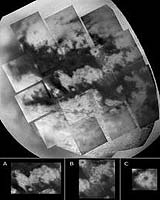
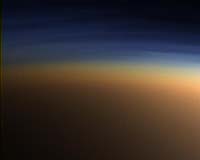
Moffett Field CA (SPX) May 26, 2005 Thanks to a thick veil of orange smog, the surface of Titan has always been bathed in hazy uncertainty. Our view of Titan sharpened with the arrival of the Cassini spacecraft, which has been performing a slow dance through Saturn's system since June of 2004. By peeking through Titan's hydrocarbon shroud, Cassini has discovered what may be two large impact craters. Impact craters are the birthday candles of a planet's surface. A heavily cratered body like our Moon indicates a long-dead world, a place where not much happens to disturb the surface. An active planet that is constantly changing, such as the Earth, has far fewer impact craters visible on its face. The geological or atmospheric activity of a world may be related to its prospects for life. The geologically inert, airless Moon is not thought to be capable of sustaining life as we know it. Whereas the Earth, with its weather, erosion, volcanism, and tectonic burial and uplift, has energy to spare, and life thrives in part because of this energy. Titan may be another place in the solar system where life could gain a foothold. Although Titan is very cold - the average surface temperature is about 94 degrees Kelvin (minus 291 Fahrenheit) - it does have a thick atmosphere full of churning chemical reactions. Titan also may have ice volcanoes erupting on the surface, places that could potentially provide energetic havens for at least single-celled life. Robert Nelson of NASA's Jet Propulsion Laboratory says that Titan was long thought to be the fresh-faced ing�nue of the solar system, with a dynamic weather system that kept the surface even younger than Earth's. "The Titan model that we had been working with had thunderstorms of methane and ethane, with oceans and winds all over," says Nelson. "But Titan seems to be a lot more mild and benign then we had previously thought." The proposed oceans of liquid hydrocarbons have not been found. And while images taken by the Huygens probe show river channels that may have formed as a result of methane rain showers, it is not known how often such storms occur, or even if they occur at all. Scientists do think that chemical reactions in Titan's atmosphere result in a nearly continuous snowfall of dark organic sludge. Ralph Lorenz of the Lunar and Planetary Lab at the University of Arizona notes that, if this sludge has been falling over the age of the solar system, it could be several hundred meters deep by now. Such an accumulation could hide many surface features, although craters deeper than a kilometer (or mountains taller than a kilometer) should still be visible. Small impact craters aren't seen in the Cassini images, but their absence is probably not due to burial. Instead, Titan's thick atmosphere causes smaller meteorites to burn up before they can reach the moon's surface. Larger meteorites should have hit Titan on a regular basis. Mimas, Tethys and other satellites of Saturn have many large impact craters, and it doesn't seem likely that Titan should have escaped the fate of its neighbors. But because only two large impact craters on Titan have been discovered so far, this suggests Titan's surface is extremely young and changeable, with the missing craters having been buried or otherwise obliterated by weather or geologic processes. However, Nelson thinks the two craters could point to a more ancient surface. Both impact craters are quite large - one is 80 kilometers across, the second is 440 kilometers across - and Nelson says that such large craters tend to be extremely old. Billions of years ago, when the solar system was still forming, everything was essentially an asteroid swirling around the sun. These "planetesimals" grew larger by slamming into each other, and eventually formed planetary cores. As time went on, there were fewer big asteroids remaining in this celestial collision course to make large impact craters. Nelson says that because large, presumably old craters have been preserved on Titan's surface, then the surface can't have changed very much over time. Of course, the equation "big crater = old crater" does not always hold true. The dinosaurs on Earth were privy to that fact when a meteorite carved out a huge 180-kilometer wide crater a mere 65 million years ago.

|