|
 |
 |
 |
 |
 |
 |
 |
 |

 |
Titanic Crunch, Squelch Or Splash?
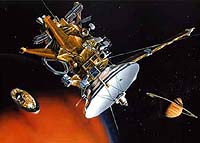
Wiltshite, UK (SPX) Nov 05, 2004 Titan still offers all possibilities for the Huygens probe landing. The prospect of the Huygens probe landing on a hard, soft or liquid surface when it lands on Titan next January still remain following further analysis of data taken during the Cassini mother ship's closest encounter with Saturn's largest moon during its fly-by on 26th October. Commenting on the latest data results and implications for the Huygens probe Mark Leese of the Open University, Programme Manager for Science Surface Package [SSP] instruments that will unravel the mysteries of Titan said: "It's interesting that all of the possible landing scenarios that we envisaged - a hard crunch onto ice, a softer squelch into solid organics or a splash-down on a liquid hydrocarbon lake - still seem to exist on Titan." Leese added, "A first look at the measurements of Titan's atmosphere during the fly-by suggest that the "Atmosphere Model" we developed and used to design the Huygens probe is valid and all looks good for the probe release on Christmas day and descent to the surface on 14th January 2005." Further analysis of Titan's upper atmosphere, the thermosphere, has revealed a strange brew as Dr Ingo Mueller-Wodarg of Imperial College London explained," Our instrument, the Ion Neutral Mass Spectrometer (INMS), made in-situ measurements of atmospheric gases in Titan's upper atmosphere and found a potent cocktail of nitrogen and methane, stirred up with signatures of hydrogen and other hydrocarbons. We are now working on a 'Weather Report' for the Huygens landing in January". Commenting on the surface characteristics of Titan Professor John Zarnecki of the Open University, lead scientist for the Huygens SSP said: "The recent results from the fly-by have started to show us a very diverse and complicated surface. Titan is geologically active but hasn't yet given up all of its secrets." "Combining the visible images with infrared and RADAR data from this and future fly-bys should help to clarify the picture - but the arrival of the Huygens probe in January will perhaps be the key to unlock these mysteries." Professor Carl Murray, of the Imaging Science System [ISS] team from Queen Mary, University of London also commented on the surface features: "The images of the Huygens' landing site returned by the cameras show a diverse range of features. We see bright and dark areas roughly aligned in an east-west direction." "These are similar to wind streaks seen on Mars and may indicate that material on Titan has been deposited by the effects of wind blowing across the landscape." "All indications suggest that we are in for a real treat in January when the Huygens probe reaches Titan's surface and returns the first in situ data from this alien world." UK scientists and technologists are amongst an international team continuing to analyse the latest data received from the NASA/ESA/ASI Cassini Huygens mission after the spacecraft made its close fly-by of Titan last week. The data has provided a wealth of information about Saturn's largest moon, which will not only assist the European Space Agency's Huygens team in advance of the probe landing on Titan in January 2005 but will also increase our understanding of the relationship between Titan and its parent planet Saturn. Professor Michele Dougherty from Imperial College is lead scientist on the Cassini Magnetometer, which is studying the interaction between the plasma in Saturn's magnetosphere and the atmosphere and ionosphere of Titan. "We have been able to model the Magnetometer data very well from the Titan flyby. There does not seem to be an internal magnetic field at Titan from the observations we obtained during this flyby, but we will have a much better idea about this when we have a further flyby in December which is on a very similar trajectory." "All we can say at this point is that if there is a magnetic field generated in the interior of Titan, then it is very small" Dr Andrew Coates from University College London's Mullard Space Science Laboratory, a Co-Investigator on the Cassini Electron Spectrometer team, said: "We received some remarkable new information about Titan's plasma environment within the context of Saturn's fascinating magnetosphere. Unexpectedly, it looks like we can directly use features of the electron results to understand what Titan's upper atmosphere is made of, supplementing the ion measurements from companion sensors on other instruments." "Our electron results contain tell-tale fingerprints of photoelectrons and Auger electrons which we will use for this." Also, the total picture shows how important electrons, raining down on Titan's upper atmosphere, are in helping the feeble sunlight drive the complex chemistry in Titan's upper atmosphere." Community Email This Article Comment On This Article Related Links PPARC SpaceDaily Search SpaceDaily Subscribe To SpaceDaily Express Explore The Ring World of Saturn and her moons Jupiter and its Moons The million outer planets of a star called Sol News Flash at Mercury
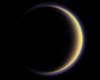
 Cassini Images Halo Around Titanic Moon Off Saturn
 Pasadena CA (SPX) Dec 27, 2005
With its thick, distended atmosphere, Titan's orange globe shines softly, encircled by a thin halo of purple light-scattering haze. |
|
|

| The content herein, unless otherwise known to be public domain, are Copyright 1995-2006 - SpaceDaily.AFP and UPI Wire Stories are copyright Agence France-Presse and United Press International. ESA PortalReports are copyright European Space Agency. All NASA sourced material is public domain. Additionalcopyrights may apply in whole or part to other bona fide parties. Advertising does not imply endorsement,agreement or approval of any opinions, statements or information provided by SpaceDaily on any Web page published or hosted by SpaceDaily. Privacy Statement |