
 |
 |
 |
 |
 |
 |
 |
 |
 |

 |

Syracuse NY (SPX) Jan 06, 2011 A team led by Patrick T. Mather, director of Syracuse Biomaterials Institute (SBI) and Milton and Ann Stevenson professor of biomedical and chemical engineering in Syracuse University's L.C. Smith College of Engineering and Computer Science (LCS), has succeeded in applying the concept of functionally graded materials (FGMs) to shape memory polymers (SMPs). SMPs are a class of "smart" materials that can switch between two shapes, from a fixed (temporary) shape to a predetermined permanent shape. Shape memory polymers function as actuators, by first forming a heated article into a temporary shape and cooling. Then, by using a second stimulus (i.e. heat), the article can spring back to its original shape. To date, SMPs have been limited to two-way and three-way shape configurations. Mather has successfully built a process where sections of one shape memory polymer independently react to different temperature stimuli. This work has been highlighted on the cover of the January 2011 issue of Soft Matter, the leading journal in the field of soft matter research. Functionally graded materials are defined as synthetic materials where the composition, microstructure and other properties differ along sections of the material. The goal of Mather's research was to apply this theory to SMPs and create a material that could be fixed and recovered in one section without impacting the response of the other sections. Mather created a temperature gradient plate by applying heat at one end and using a cooling unit at the other end. The actual temperature gradient was verified by measuring different positions along the plate. The SMP was cured on this plate to set the different transition temperatures. Mather first tested the graded SMP by using micro-indention on the surface and then heating the polymer. When heated, each indentation recovered to the original smooth surface as each one's transition temperature was reached along the surface. The second test involved cutting the SMP and bending back the cut sections. This SMP was placed on a Pelletier plate that uniformly heated the material. It was observed that as the plate warmed, each "finger" of the cut sheet independently recovered back to its unbent shape as the temperature of the plate reached its transition temperature. "We are very excited about this new approach to preparing shape memory polymers, which should enable new devices with complex mechanical articulations," says Mather. "The project demonstrated how enthusiastic and persistent undergraduate researchers could contribute substantively, even in the throes of their busy course schedules." There are numerous applications opportunities for Mather's functionally graded SMPs, from low-cost temperature labels that could measure temperatures in areas that are not accessible by conventional methods or not amenable to continuous monitoring, to indirectly indicate sterilization completions, or for incorporation into product packaging (for shipping industry or food storage) to indicate the maximum temperature for a product exposure. The LCS team of researchers led by Mather included graduate student Xiaofan Luo and undergraduate student Andrew DiOrio.
Share This Article With Planet Earth
Related Links Syracuse Biomaterials Institute (SBI) Space Technology News - Applications and Research

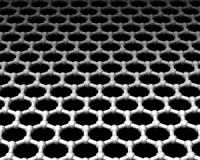 Graphene Grains Make Atom-Thick Patchwork Quilts
Ithaca NY (SPX) Jan 06, 2011 Cornell University researchers have unveiled striking, atomic-resolution details of what graphene "quilts" look like at the boundaries between patches, and have uncovered key insights into graphene's electrical and mechanical properties. Researchers focused on graphene - a one atom-thick sheet of carbon atoms bonded in a crystal lattice like a honeycomb or chicken wire - because of its ele ... read more |
|
|
| The content herein, unless otherwise known to be public domain, are Copyright 1995-2010 - SpaceDaily. AFP and UPI Wire Stories are copyright Agence France-Presse and United Press International. ESA Portal Reports are copyright European Space Agency. All NASA sourced material is public domain. Additional copyrights may apply in whole or part to other bona fide parties. Advertising does not imply endorsement,agreement or approval of any opinions, statements or information provided by SpaceDaily on any Web page published or hosted by SpaceDaily. Privacy Statement |


 del.icio.us
 Digg
Digg Reddit
 YahooMyWeb
 Google
 Facebook


