|
 |
 |
 |
 |
 |
 |
 |
 |

 |
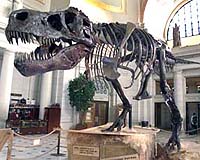
T Rex Quicker Than Becks
Manchester UK (SPX) Aug 22, 2007 T. rex may have struggled to chase down speeding vehicles as the movie Jurassic Park would have us believe but the world's most fearsome carnivore was certainly no slouch, research out today suggests. The University of Manchester study used a powerful supercomputer to calculate the running speeds of five meat-eating dinosaurs that varied in size from a 3kg Compsognathus to a six-tonne Tyrannosaurus. The study - believed to be the most accurate ever produced - puts the T. rex at speeds of up to 18mph, fractionally quicker than a sportsman such as a professional footballer. The bipedal Compsognathus, by comparison, could reach speeds of almost 40mph - that's 5mph faster than the computer's estimate for the fastest living animal on two legs, the ostrich. The team - headed by biomechanics expert Bill Sellers and palaeontologist Phil Manning - say the accuracy of their results is due to the computer's ability to use data relating directly to each dinosaur. "Previous research has relied on data from extant bipedal models to provide clues as to how fast dinosaurs could run," said Dr Sellers, who is based in Manchester's Faculty of Life Sciences. "Such calculations can accurately predict the top speed of a six-tonne chicken but dinosaurs are not built like chickens and nor do they run like them. "Our research involved feeding information about the skeletal and muscular structure of the dinosaurs directly into the supercomputer so it could work out how the animals were best able to move." Despite its powerful memory and 256 processors the computer still took up to a week to learn the biomechanics of each animal - starting with the first clumsy steps and developing into a top running speed based on the optimum gait and posture. The first data to be fed into the computer were those of a 70kg human with the muscle and bone structure of a professional sportsman. The computer accurately predicted a top running speed of just under the 8 metres per second of T. rex. Musculoskeletal details of a 30kg South American emu and a 65kg ostrich were fed into the program next and top running speeds of 13m/s (about 30mph) and 15m/s (35mph) were calculated respectively. The process was then repeated using the musculoskeletal data of five bipedal meat-eating dinosaurs - a 3kg Compsognathus, a 20kg Velociraptor, a 430kg Dilophosaurus, a 1.4 tonne Allosaurus and the 6 tonne Tyrannosaurus. "The figures we have produced are the best estimate to date as to how fast these prehistoric animals could run," said collaborator Dr Manning, a lecturer in palaeontology in the School of Earth, Atmospheric and Environmental Sciences. "Since the movie Jurassic Park, scientists have questioned the speed of these dinosaurs and some have wondered whether Tyrannosaurus could have run at all. "Our research, which used the minimum leg-muscle mass T. rex required for movement, suggests that while not incredibly fast, this carnivore was certainly capable of running and would have little difficulty in chasing down footballer David Beckham for instance." Community Email This Article Comment On This Article Related Links University of Manchester Darwin Today At TerraDaily.com
 Male Elephants Get Photo IDs From Scientists
 Washington DC (SPX) Aug 20, 2007
Asian elephants don't carry photo identification, so scientists from the Wildlife Conservation Society and India's Nature Conservation Foundation are providing the service free of charge by creating a photographic archive of individual elephants, which can help save them as well. |
|
|

| The content herein, unless otherwise known to be public domain, are Copyright 1995-2007 - SpaceDaily.AFP and UPI Wire Stories are copyright Agence France-Presse and United Press International. ESA Portal Reports are copyright European Space Agency. All NASA sourced material is public domain. Additional copyrights may apply in whole or part to other bona fide parties. Advertising does not imply endorsement,agreement or approval of any opinions, statements or information provided by SpaceDaily on any Web page published or hosted by SpaceDaily. Privacy Statement |