|
 |
 |
 |
 |
 |
 |
 |
 |

 |
THEMIS Will Judge What Causes Highly Dynamic Aurora
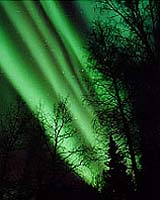
Pasadena CA (SPX) Jan 18, 2007 On a clear night over the far northern areas of the world, you may witness a hauntingly beautiful light display in the sky that can disrupt your satellite TV and leave you in the dark. The eerie glow of the northern lights seems exquisite and quite harmless. Most times, it is harmless. The display, resembling a slow-moving ribbon silently undulating in the sky, is called the aurora. It is also visible in far southern regions around the South Pole. Occasionally, however, the aurora becomes much more dynamic. The single auroral ribbon may split into several ribbons or even break into clusters that race north and south. This dynamic light show in the polar skies is associated with what scientists call a magnetospheric substorm. Substorms are very closely related to full-blown space storms that can disable spacecraft, radio communication, GPS navigation, and power systems while supplying killer electrons to the radiation belts surrounding Earth. The purpose of NASA's Time History of Events and Macroscale Interactions during Substorms (THEMIS) mission is to understand the physical instability (trigger mechanism) for magnetospheric substorms. A clash of forces we can't see with the human eye causes the beauty and destruction of space storms, though the aurora provides a dramatic symptom. Earth's molten iron core generates an invisible magnetic field that surrounds our planet. This magnetic field and the electrically charged matter under its control compose the Earth's magnetosphere. The sun constantly blows an invisible stream of electrically charged gas, called the solar wind, into space. The solar wind flows at very high speed past the Earth and its magnetosphere. In order to visualize what happens when the solar wind buffets the Earth's magnetosphere, imagine a windsock in a gale force wind. The Earth's magnetosphere captures and stores small fractions of the colliding solar wind energy and particles on magnetic field lines that stretch like rubber bands. During substorms, the solar wind overloads the magnetosphere with too much energy and the stretched magnetic field lines snap back like an enormous slingshot, energizing and flinging electrically charged particles towards Earth. Electrons, the particles that carry electric currents in everything from TVs to cell phones, stream down invisible lines of magnetic force into the upper atmosphere over the polar regions. This stream of electrons hits atoms and molecules in the upper atmosphere, energizing them and causing them to glow with the light we know as the aurora. The same electrons sometimes charge spacecraft surfaces, resulting in unexpected and unwanted electrical discharges. And those electrons that enter the radiation belts can ultimately find their energies boosted to levels millions of times more energetic than the photons that comprise the light we can see. Electrons with these energies can damage sensitive electronics on spacecraft and rip through molecules in living cells, potentially causing cancer in unshielded astronauts. Rapidly varying magnetic fields associated with magnetospheric substorms also induce electric currents in power lines that can cause blackouts by overloading equipment or causing short circuits. Although the consequences of substorms are well-known, it is not clear exactly what finally snaps in the overloaded magnetosphere to trigger a substorm. Understanding what happens during substorms is important. "The worst space storms, the ones that knock-out spacecraft and endanger astronauts, could be just a series of substorms, one after the other," said David Sibeck of NASA's Goddard Space Flight Center in Greenbelt, Md., project scientist for the THEMIS mission. "Substorms could be the building block of severe space storms." Just like meteorologists who study tornadoes to understand the most severe thunderstorms, space physicists study substorms for insight into the most severe space storms. "Substorm processes are fundamental to our understanding of space weather and how it affects satellites and humans in the magnetosphere," said Vassilis Angelopoulos, THEMIS principal investigator at the University of California's Berkeley Space Sciences Laboratory, in Berkeley, Calif. Scientists propose two possible triggers for substorms, but until now, there has been no way to distinguish between the two models. Discerning between the two proposed substorm trigger mechanisms is difficult because the magnetosphere is so large. Over Earth's night (solar wind down-stream) side, the solar wind stretches the magnetosphere far past the moon's orbit, to form the geomagnetic tail. Substorms start from a small region in space inside the geomagnetic tail, but within minutes cover a vast region of the magnetosphere. However, the two proposed trigger mechanisms predict substorm onset in distinctly different locations within the geomagnetic tail, so the key to solving this mystery lies in identifying the substorm point of origin. Previous single-spacecraft studies of the Earth's magnetosphere have been unable to pinpoint where and when substorms begin, leading to extensive scientific debate on the topic. However, NASA's THEMIS mission will solve this mystery with coordinated measurements from a fleet of five identical satellites, strategically placed in key positions in the magnetosphere, in order to isolate the point of substorm origin. The mission, named for Themis, the blindfolded Greek Goddess of Order and Justice, will resolve this debate like a fair, impartial judge. THEMIS is scheduled for launch in February. When the five probes align over the North American continent, scientists will collect coordinated measurements down-stream of Earth, along the sun-Earth line, allowing the first comprehensive look at the onset of substorms and how they trigger auroral eruptions. Over the mission's two-year lifetime, the probes should be able to observe some 30 substorms. Down-stream alignments have been carefully planned to occur over North America once every four days. For about 15 hours surrounding the alignments, 20 ground stations in Canada and Alaska with automated all-sky cameras will document the aurora from Earth. The combined spacecraft and ground observations will give scientists the first comprehensive look at the phenomena from Earth's upper atmosphere to far into space, enabling researchers to pinpoint where and when substorm initiation begins. Community Email This Article Comment On This Article Related Links NASA Time History of Events and Macroscale Interactions during Substorms (THEMIS) mission Stellar Chemistry, The Universe And All Within It Solar Science News at SpaceDaily
 US Researchers Study Space Weather
 Beijing (SPX) Jan 05, 2007
Johnathan Makela doesn't have his head in the clouds, but one could say he's "spaced out" when it comes to weather. Makela, a University of Illinois electrical- and computer-engineering professor, isn't concerned about the first six or seven miles of Earth's atmosphere -- where clouds and storms form -- he's trying to discover a way to forecast the weather in the ionosphere, the region of Earth's atmosphere found about 45 to 600 miles above the planet. |
|
|

| The content herein, unless otherwise known to be public domain, are Copyright 1995-2006 - SpaceDaily.AFP and UPI Wire Stories are copyright Agence France-Presse and United Press International. ESA PortalReports are copyright European Space Agency. All NASA sourced material is public domain. Additionalcopyrights may apply in whole or part to other bona fide parties. Advertising does not imply endorsement,agreement or approval of any opinions, statements or information provided by SpaceDaily on any Web page published or hosted by SpaceDaily. Privacy Statement |