|
 |
 |
 |
 |
 |
 |
 |
 |

 |
US Researchers Study Space Weather
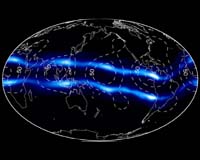
Beijing (SPX) Jan 05, 2007 Johnathan Makela doesn't have his head in the clouds, but one could say he's "spaced out" when it comes to weather. Makela, a University of Illinois electrical- and computer-engineering professor, isn't concerned about the first six or seven miles of Earth's atmosphere -- where clouds and storms form -- he's trying to discover a way to forecast the weather in the ionosphere, the region of Earth's atmosphere found about 45 to 600 miles above the planet. Because what goes on in the ionosphere -- so named because it is heavily ionized by the sun's radiation -- can have dramatic effects on satellite communications, air travel and power grids. But forecasting so-called space weather isn't very advanced. Scientists can now project what will happen about an hour or two in advance, Makela said. "We're not there yet," he said. "We're at the stage that meteorology was 50 (years ago)." The sun has a strong influence on space weather, so Makela and fellow scientists at Cornell and Virginia Tech study what happens there and how it influences the ionosphere. High levels of radiation passing through the ionosphere can knock out satellite-based communications, or the flow of electricity to homes and businesses on Earth. A solar storm in 2003 left thousands of homes in Sweden without power while also disrupting radio broadcasts and airline flight schedules. Makela and his colleagues have devised a way to create a sort of ionospheric equivalent of the animated weather maps seen on TV and the Internet. They take digital images of variations in what's known as airglow over the equator. Airglow is the weak light emitted by Earth's atmosphere, faintly visible at night in even the darkest skies. The camera, known as the narrow-field ionospheric airflow imager, takes long-exposure images from an observatory in Chile. "We just connect to the Internet every day and download data," Makela said. Makela and his colleagues' eventual goal is to be able to better predict space weather so communications companies, electric utilities and others can protect themselves from its effects. Community Email This Article Comment On This Article Related Links Solar Science News at SpaceDaily Solar Science News at SpaceDaily
 1000th Orbit For The Cluster Mission
 Paris, France (ESA) Jan 04, 2007
29 December 2006, marks the 1000th orbit around the Earth of the four ESA satellites composing the Cluster mission. Launched in the summer 2000, these spacecraft are delivering a unique harvest of in-situ scientific data of the Earth environment, from 25 000 to 125 000 kilometres altitude. |
|
|

| The content herein, unless otherwise known to be public domain, are Copyright 1995-2006 - SpaceDaily.AFP and UPI Wire Stories are copyright Agence France-Presse and United Press International. ESA PortalReports are copyright European Space Agency. All NASA sourced material is public domain. Additionalcopyrights may apply in whole or part to other bona fide parties. Advertising does not imply endorsement,agreement or approval of any opinions, statements or information provided by SpaceDaily on any Web page published or hosted by SpaceDaily. Privacy Statement |