
 |
 |
 |
 |
 |
 |
 |
 |
 |

 |
Successful Demonstration Of High Power Electric Propulsion System For TSAT
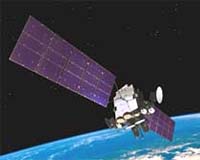
Sunnyvale CA (SPX) Jul 25, 2008 The Lockheed Martin and Northrop Grumman Transformational Satellite Communications System (TSAT) Space Segment team has completed a successful demonstration of its new-generation High Power Hall Current Thruster (HPHCT) electric propulsion system designed for use on the U.S. Air Force's TSAT constellation. TSAT will provide thousands of military users with wideband, highly mobile, beyond line-of-sight protected communications to support network-centric operations for the future battlefield. Developed by Lockheed Martin and Aerojet, the Hall Current propulsion technology provides significantly improved fuel efficiency over conventional chemical propulsion systems. The Hall Current Thruster system will be used for both orbit transfer, as well as on-orbit station keeping. Aerojet has over 30 years of experience developing and supplying the electric propulsion needs for critical military, civil and commercial satellites. "We are extremely pleased with the performance of our next-generation TSAT thruster system," said Mark Pasquale, Lockheed Martin's TSAT vice president. "Successful demonstration and validation of thruster capability during the risk reduction and system definition phase is a key achievement for the entire team and represents another major milestone for this critical national program." Leveraging the highly-successful 4.5 kW Hall Current Thruster System for the Advanced Extremely High Frequency (AEHF) program, the TSAT-developed HPHCT yields a greater dry mass to orbit capability enabling the Lockheed Martin/Northrop Grumman TSAT Team to provide a low risk cost effective solution that accommodates the demanding mission requirements for the TSAT program. TSAT represents the next step toward transitioning the Department of Defense protected communications satellite architecture into a single network comprising multiple satellite, ground, and user segment components. The system ultimately will replace the Milstar and AEHF programs and provide the Global Information Grid network extension to mobile warfighters, sensors, weapons, and command, control, and communications nodes located on unmanned aerial vehicles, piloted aircraft, on the ground, in the air, at sea or in space. The Lockheed Martin / Northrop Grumman TSAT space segment team, which includes Juniper Networks, Inc., Sunnyvale, Calif., ViaSat, Carlsbad, Calif., and Lockheed Martin Information Systems and Global Services, Gaithesburg, Md. is currently working under a contract for the Risk Reduction and System Definition phase. This effort will culminate with a multi-billion dollar development contract to be awarded to a single contractor in late 2008. The Military Satellite Communications Systems Wing, located at the Space and Missile Systems Center, Los Angeles Air Force Base, Calif., is the TSAT contract manager and lead agency for ensuring the capabilities of this system are made available to the warfighter. Community Email This Article Comment On This Article Share This Article With Planet Earth
Related Links Read the latest in Military Space Communications Technology at SpaceWar.com
 US Navy Selects Next Gen Command And Control Processor
 San Diego CA (SPX) Jul 24, 2008
The U.S. Navy has selected Northrop Grumman to develop the Next Generation Command and Control Processor (NGC2P). The one-year contract, with four additional option years, is valued at $218 million if all options are exercised. Northrop Grumman has received $3.3 million to commence work on NGC2P. |
|
|

| The content herein, unless otherwise known to be public domain, are Copyright 1995-2007 - SpaceDaily.AFP and UPI Wire Stories are copyright Agence France-Presse and United Press International. ESA Portal Reports are copyright European Space Agency. All NASA sourced material is public domain. Additional copyrights may apply in whole or part to other bona fide parties. Advertising does not imply endorsement,agreement or approval of any opinions, statements or information provided by SpaceDaily on any Web page published or hosted by SpaceDaily. Privacy Statement |
 del.icio.us
 Digg
Digg Reddit
 YahooMyWeb
 Google
 Facebook