|
 |
 |
 |
 |
 |
 |
 |
 |

 |
Successful Arianespace Service Introduction For The Soyuz 2-1B Launcher
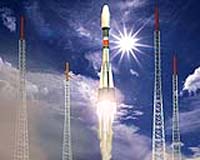
Paris, France (SPX) Dec 28, 2006 The upgraded Soyuz 2-1b launch vehicle successfully performed its inaugural flight today (December 27), placing Europe's COROT astronomy satellite into a circular polar orbit. In a mission performed under the joint responsibility of Arianespace and its Starsem affiliate, the enhanced Soyuz lifted off from Kazakhstan's Baikonur Cosmodrome and deployed COROT after a flight of 50 minutes. The Soyuz 2-1b has an increased-performance third stage engine, which is in addition to flight control and system upgrades already validated on the Soyuz 2-1a version - which has flown three times. Arianespace will use the improved Soyuz for commercial operations from Europe's Spaceport in French Guiana. It will become the medium-weight launcher of reference, joining Arianespace's heavy-lift Ariane 5 and the lightweight Vega in a comprehensive family of vehicles. Soyuz launchers will be processed horizontally and erected on the pad some 18 hours before liftoff. Approved by ESA's council in February 2004, the ELS is under construction at the Malmanoury site, some 6 km West of the Ariane Launch Complexes and is planned to be operational for launches of Russian-built Soyuz launchers in 2006. The Soyuz launcher, an offspring of the R-7 ballistic missile, is the most used and the most reliable launcher in the world, with some 1700 launches of satellites or manned flights since the first Sputnik was put into orbit in 1957 and since the first man, Yuri Gagarin, was sent into space in 1961. Since 1996, the European-Russian company, Starsem, has been marketing the Soyuz launcher, which is routinely launched from the Baikonur cosmodrome, Kazakhstan. From Kourou, Soyuz launchers will be able to launch up to 2.5 tonnes to geostationary transfer orbit (GTO), thus complementing the launcher family formed by Ariane 5, which provides heavy lift capacity of up to 10 tonnes to GTO, and Vega, for light launches to low Earth orbits.Credits: ESA-D. DUCROs Community Email This Article Comment On This Article Related Links Arianespace Launch Pad at Space-Travel.com Launch Pad at Space-Travel.com
 Russia Remains Leader In Spacecraft Launches
 Moscow, Russia (RIA Novosti) Dec 27, 2006
Russia conducted 45% of the world's spacecraft launches in 2006, maintaining its leading position, the head of the Federal Space Agency said Tuesday. "Russia's current share in the spacecraft launch market is about 40%, and counting joint Russian-Ukrainian launches from the Sea Launch platform it totals about 45% of all launches conducted in the world," Anatoly Perminov said at a year-end news conference. |
|
|

| The content herein, unless otherwise known to be public domain, are Copyright 1995-2006 - SpaceDaily.AFP and UPI Wire Stories are copyright Agence France-Presse and United Press International. ESA PortalReports are copyright European Space Agency. All NASA sourced material is public domain. Additionalcopyrights may apply in whole or part to other bona fide parties. Advertising does not imply endorsement,agreement or approval of any opinions, statements or information provided by SpaceDaily on any Web page published or hosted by SpaceDaily. Privacy Statement |