|
 |
 |
 |
 |
 |
 |
 |
 |

 |
Russia Remains Leader In Spacecraft Launches
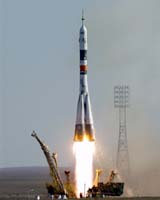
Moscow, Russia (RIA Novosti) Dec 27, 2006 Russia conducted 45% of the world's spacecraft launches in 2006, maintaining its leading position, the head of the Federal Space Agency said Tuesday. "Russia's current share in the spacecraft launch market is about 40%, and counting joint Russian-Ukrainian launches from the Sea Launch platform it totals about 45% of all launches conducted in the world," Anatoly Perminov said at a year-end news conference. In 2006, Russia already conducted 24 launches, and plans to launch a Soyuz-2-1B carrier rocket with a Fregat booster and a French Corot satellite December 27, Perminov said, adding that in 2007 the number of launches will be reduced to about 20. Perminov said Russia will allocate 24.04 billion rubles ($912.3 million) for the Federal Space Program in 2007. "The budget for the Federal Space Program in 2006 totaled 23 billion rubles ($873 million), and in 2007 it will reach 24.04 billion rubles, without additional revenues," the official said. The head of the space agency also said the United States was in second place in spacecraft launches, with 18 launches conducted in 2006, while Japan and China shared third place with six launches each. The U.S. will use Russian spacecraft to fly its astronauts to the International Space Station after 2010, he said. "Until 2010, the U.S. will use its space shuttles [to bring astronauts to the ISS], but after 2010 and until 2015-2020 they [the Americans] will fly to the station on board the Russian spacecraft," Perminov said, adding that Russia will start building its own space shuttles, the Clipper, in 2012. In 2007, Russia will send two piloted spacecraft and four cargo ships to the ISS, he said. "We have determined that one place in the Soyuz spacecraft will be always reserved for a Russian cosmonaut, another - for an American astronaut, and the third will be offered to space tourists," Perminov said. "The list of space tourists from various countries has been filled in until 2008." The official said Russia will complete in 2009 the creation of its GLONASS satellite navigation network, which is similar to the U.S. GPS global positioning system. "We have no doubt that in 2009 we will complete the GLONASS network, which consists of 24 satellites, and [precise] navigation will be possible anywhere on Earth," Perminov said. He also urged countries involved in space exploration to develop international rules for cleaning up "space garbage." "We need a system of international measures for regulating the clean-up of space garbage," Perminov said. "Unfortunately, it does not exist at present, but we are discussing it." Speaking about international cooperation in Moon exploration, the Russian space chief said Russia will not join the U.S. in its program, but will develop its own unmanned exploration techniques. "Russia will study the Moon using unmanned methods, meaning with the help of robotic equipment," Perminov said. "We are fully cooperating with China in this area." He wrapped up his news conference with a comment that the Federal Space Agency in 2007 will develop Russia's space exploration strategy until 2040.
Source: RIA Novosti Community Email This Article Comment On This Article Related Links Russian Federal Space Agency Travelling through Space Launch Pad at Space-Travel.com
 Arianespace Provides A Key Boost For The US Satellite Market In 2006
 Washington DC (SPX) Dec 21, 2006
Arianespace maintained its commercial launch services leadership in 2006, with the U.S. marketplace representing a key component of the payloads launched and new contracts signed. The company's workhorse Ariane 5 launched a total of 10 telecommunications satellites this year - more than all the competitors combined - of which 7 were built by U.S. manufacturers, and 3 were orbited for American-based operators. |
|
|

| The content herein, unless otherwise known to be public domain, are Copyright 1995-2006 - SpaceDaily.AFP and UPI Wire Stories are copyright Agence France-Presse and United Press International. ESA PortalReports are copyright European Space Agency. All NASA sourced material is public domain. Additionalcopyrights may apply in whole or part to other bona fide parties. Advertising does not imply endorsement,agreement or approval of any opinions, statements or information provided by SpaceDaily on any Web page published or hosted by SpaceDaily. Privacy Statement |