|
 |
 |
 |
 |
 |
 |
 |
 |

 |
Steep Oxygen Decline Halted First Land Colonization By Earth's Sea Creatures
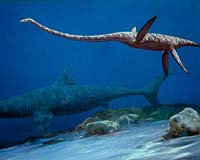
Seattle WA (SPX) Oct 24, 2006 Vertebrate creatures first began moving from the world's oceans to land about 415 million years ago, then all but disappeared by 360 million years ago. The fossil record contains few examples of animals with backbones for the next 15 million years, and then suddenly vertebrates show up again, this time for good. The mysterious lull in vertebrate colonization of land is known as Romer's Gap, named for the Yale University paleontologist, Alfred Romer, who first recognized it. But the term has typically been applied only to pre-dinosaur amphibians, and there has been little understanding of why the gap occurred. Now a team of scientists led by University of Washington paleontologist Peter Ward has found a similar gap during the same period among non-marine arthropods, largely insects and spiders, and they believe a precipitous drop in the oxygen content of Earth's atmosphere is responsible. "These two groups acted exactly the same way. They proliferated, then they went away, and then they reappeared and multiplied like crazy," said Ward, a UW professor of biology and of Earth and space sciences. He notes that atmospheric oxygen rose sharply at the end of the Silurian period about 415 million years ago, to reach a level of about 22 percent of the atmosphere, similar to today's oxygen content. But 55 million years later, atmospheric oxygen levels sank to 10 percent to 13 percent. The level remained low for 30 million years � during which Romer's Gap occurred � then shot up again, and vertebrates and arthropods again began moving from the sea to land. "It matches two waves of colonization of the land," Ward said. "In the first wave the animals' lungs couldn't have been very good and when the oxygen level dropped it had to be hard for the vertebrates coming out of the water. I wonder if there is a minimum level of oxygen that has to be reached or nothing could ever have gotten out of the water." Dinosaurs first appeared in the last part of the Triassic period, about 230 million years ago. That was during one of the lowest ebbs of atmospheric oxygen content of the last 500 million years, but he speculates that it took some time, until oxygen levels rose appreciably, before dinosaurs grew to their familiar gargantuan sizes. "Dinosaurs thrived and nothing else did. There's an explanation for that, and it is that the air sac breathing system in dinosaurs and their descendants, modern birds, is more efficient than systems used by other organisms," Ward said. He and his colleagues tested that hypothesis by examining the breathing system used by birds. They found that at sea level birds breathe 30 percent more efficiently than mammals and at 5,000 feet in elevation birds are 200 percent more efficient. Ward pictures a world in which dinosaurs were able to adapt to low atmospheric oxygen content relatively easily, and when oxygen levels rose the dinosaurs developed into giant creatures that dominated the Earth. "I think of dinosaurs as the high-altitude Denver athletes of their day. They ran rings around their prey," he said. Ward also began to wonder whether respiratory needs dictated how other organisms' bodies developed. He thought that perhaps, rather than being based on feeding and movement, body shape and design might largely be determined by respiratory efficiency. For instance, a mollusk shell is typically thought of as protection for the marine creature, he said, but it turns out the shell actually channels water across the gill to deliver oxygen. "An unshelled mollusk has a far greater respiratory problem than a shelled mollusk," Ward said. "In many groups the shell is an active part of the respiratory system." Community Email This Article Comment On This Article Related Links University of Washington Darwin Today At TerraDaily.com Darwin Today At TerraDaily.com
 Bacteria That Use Radiated Water for Food
 Bloomington IN (SPX) Oct 23, 2006
Researchers from Indiana University Bloomington and eight collaborating institutions report in this week's Science a self-sustaining community of bacteria that live in rocks 2.8 kilometers below Earth's surface. Think that's weird? The bacteria rely on radioactive uranium to convert water molecules to useable energy. |
|
|

| The content herein, unless otherwise known to be public domain, are Copyright 1995-2006 - SpaceDaily.AFP and UPI Wire Stories are copyright Agence France-Presse and United Press International. ESA PortalReports are copyright European Space Agency. All NASA sourced material is public domain. Additionalcopyrights may apply in whole or part to other bona fide parties. Advertising does not imply endorsement,agreement or approval of any opinions, statements or information provided by SpaceDaily on any Web page published or hosted by SpaceDaily. Privacy Statement |