|
 |
 |
 |
 |
 |
 |
 |
 |

 |
Stealth Radar System Sees Through Trees And Walls Undetected
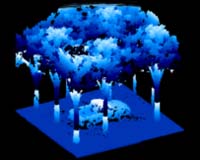
Columbus OH (SPX) Jun 27, 2006 Ohio State engineers have invented a radar system that is virtually undetectable because its signal resembles random noise. The radar could have applications in law enforcement, the military and disaster rescue. Eric Walton, senior research scientist in Ohio State's ElectroScience Laboratory, said that with further development the technology could even be used for medical imaging. He explained why using random noise makes the radar system invisible. "Almost all radio receivers in the world are designed to eliminate random noise so that they can clearly receive the signal they're looking for," Walton said. "Radio receivers could search for this radar signal and they wouldn't find it. It also won't interfere with TV, radio or other communication signals." The radar scatters a very low-intensity signal across a wide range of frequencies, so a TV or radio tuned to any one frequency would interpret the radar signal as a very weak form of static. "It doesn't interfere because it has a bandwidth that is thousands of times broader than the signals it might otherwise interfere with," Walton said. Like traditional radar, the "noise" radar detects objects by bouncing a radio signal off them and detecting the rebound. The hardware isn't expensive, either; altogether, the components cost less than $100. The difference is that the noise radar generates a signal that resembles random noise, and a computer calculates very small differences in the return signal. The calculations happen billions of times every second and the pattern of the signal changes constantly. A receiver couldn't detect the signal unless it knew exactly what random pattern was being used. The radar can be tuned to penetrate solid walls - just like the waves that transmit radio and TV signals - so the military could spot enemy soldiers inside a building without the radar signal being detected, Walton said. Traffic police could measure vehicle speed without setting off drivers' radar detectors. Autonomous vehicles could tell whether a bush conceals a more dangerous obstacle, like a tree stump or a gulley. The radar is inherently able to distinguish between many types of targets because of its ultra-wide-band characteristics. "Unfortunately, there are thousands of everyday objects that look like humans on radar - even chairs and filing cabinets," he said. So the shape of a radar image alone can't be used to identify a human. "What tends to give a human away is that he moves. He breathes, his heart beats, his body makes unintended motions." These tiny motions could be used to locate disaster survivors who were pinned under rubble. Other radar systems can't do that because they are too far-sighted - they can't see people who are buried only a few yards away. Walton said that the noise radar is inherently able to see objects that are nearby. "It can see things that are only a couple of inches away with as much clarity as it can see things on the surface of Mars," he added. That means that with further development, the radar might image tumors, blood clots and foreign objects in the body. It could even measure bone density. As with all forms of medical imaging, studies would first have to determine the radar's effect on the body. The university is expected to license the patented radar system. Community Email This Article Comment On This Article Related Links OSU Space Technology News - Applications and Research
 Bacterium Takes A Shine To Metals
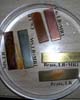 Los Angeles CA (SPX) Jun 19, 2006
Exposed metal surfaces are highly vulnerable to corrosion, but paint or other protective coatings can interfere with some uses, as well as add significant costs. Now, a comprehensive series of experiments suggests a new form of protection: bacteria. |
|
|

| The content herein, unless otherwise known to be public domain, are Copyright 1995-2006 - SpaceDaily.AFP and UPI Wire Stories are copyright Agence France-Presse and United Press International. ESA PortalReports are copyright European Space Agency. All NASA sourced material is public domain. Additionalcopyrights may apply in whole or part to other bona fide parties. Advertising does not imply endorsement,agreement or approval of any opinions, statements or information provided by SpaceDaily on any Web page published or hosted by SpaceDaily. Privacy Statement |