|
 |
 |
 |
 |
 |
 |
 |
 |

 |
Bacterium Takes A Shine To Metals
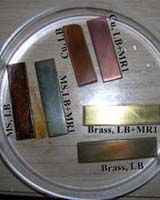
Los Angeles CA (SPX) Jun 19, 2006 Exposed metal surfaces are highly vulnerable to corrosion, but paint or other protective coatings can interfere with some uses, as well as add significant costs. Now, a comprehensive series of experiments suggests a new form of protection: bacteria. Viterbi School post-doctoral researcher Ersa Kus, is the lead author on a forthcoming report on experiments by a team of materials scientists analyzing the ability of an organism called Shewanella oneidensis MR-1 (hereinafter MR-1) to protect a number of metals. The team made a preliminary presentation at a Denver conference last month, and will make a more detailed one in Mexico in October. Scientists have long known that some bacteria can accelerate corrosion on metal surfaces, says Kus, who works in the Corrosion and Environmental Effects laboratory of Professor Florian Mansfeld of the Viterbi School's Mork Family Department of Materials Science and Chemical Engineering. A bacterium of the same genus as MR-1, S. algae, has earlier been shown to prevent pitting of aluminum and some steel. MR-1 is a remarkable organism that can incorporate metal into its metabolism, "inhaling certain metal oxides and compounds in one form, exhaling them in another," according to Kus's presentation. MR-1 has previously been used to precipitate uranium out of contaminated water. And "it can grow almost anywhere and does not cause disease in humans or animals," Kus notes. And it can protect metal. The experiment was simple. Matched pairs of samples of four metals - aluminum 2024, zinc, mild steel, copper, and brass - were prepared. One sample set of each pair was incubated in a growth medium containing MR-1; the other in a sterile bath of the same growth medium, containing neither MR-1 nor any other organism. After a week, corrosion was monitored, both visually and by measuring electrochemical impedance (resistance to conducting alternating current.) Because electrical effects play a role in many forms of corrosion, higher AC impedance is associated with increased corrosion resistance. The results were clearcut. For all the materials, impedance increased with exposure to bacteria, and the longer the metals were exposed, the more resistant they became. The increase was particularly marked in the aluminum samples. By the end of the week the control samples showed obvious visual pitting, while the ones with MR-1 colonies were unscathed. The pattern of impedance varied from metal to metal. Aluminum showed drastic reduction in resistance to electrical currents in all frequencies. Brass and, particularly copper showed nearly as dramatic an effect - readings indicated active corrosion in the control samples, but a large reduction in the MR-1 samples. The copper MR1 samples, in fact, showed a profile similar to that demonstrated by copper covered with a protective polymer plastic film. The patterns for steel and zinc were much less marked, but still significant, as was the difference in the metals' appearance. The next step, according to Kus, is to figure out exactly what is going on and determine where and how the presence of bacteria is altering the corrosion equation. To do this, the group will be making molecular scale analysis of bacteria/metal interfaces, and looking to determine what the properties of MR1 biofilm are, as well as why the pattern of interaction differs from metal to metal. While MR1 itself may not be the metal protector of the future, it may well suggest an agent that can be, Kus says. The research will be presented at the 210th Meeting of The Electrochemical Society in Cancun, Mexico, October 29-November 3, 2006 Besides Mansfeld and Kus, the research group included graduate student Orianna Bretschger and professor Kenneth H. Nealson of the USC department of Earth Sciences. Community Email This Article Comment On This Article Related Links Viterbi School Space Technology News - Applications and Research
 Faulty Design Caused Genesis Mishap
 Washington DC (SPX) Jun 14, 2006
NASA announced Tuesday that a flaw in the design of its Genesis spacecraft's sample-return capsule caused it to crash in the Utah desert in 2004. That is the conclusion of the agency's Genesis Mission Mishap Investigation Board, convened on Sept. 10, 2004 - two days after the accident. NASA has released the board's final report. |
|
|

| The content herein, unless otherwise known to be public domain, are Copyright 1995-2006 - SpaceDaily.AFP and UPI Wire Stories are copyright Agence France-Presse and United Press International. ESA PortalReports are copyright European Space Agency. All NASA sourced material is public domain. Additionalcopyrights may apply in whole or part to other bona fide parties. Advertising does not imply endorsement,agreement or approval of any opinions, statements or information provided by SpaceDaily on any Web page published or hosted by SpaceDaily. Privacy Statement |