|
 |
 |
 |
 |
 |
 |
 |
 |

 |
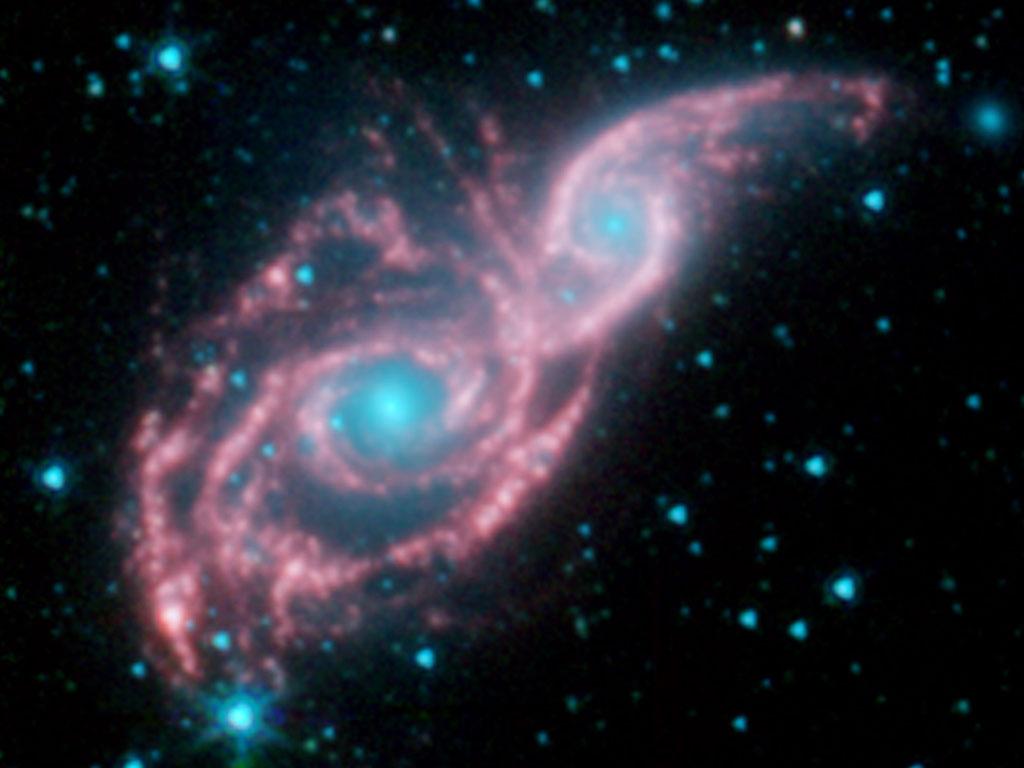
Spitzer Spies Galactic Masquerade Party Of Two
Pasadena CA (SPX) Apr 27, 2006 Spitzer Space Telescope's latest image shows a pair of galaxies peering out as though through a mask of surrounding stars. The NASA spacecraft's infrared image shows what looks like two icy blue eyes staring through an elaborate, swirling red mask - except the eyes actually are the cores of two merging galaxies - NGC 2207 and IC 2163 - locked gravitationally and began to twirl around each other. The mask in the image comprises the galaxies' twisted spiral arms. Dotted along the arms, like strings of decorative pearls, are dusty clusters of newborn stars. This is the first time clusters of this type, which astronomers call "beads on a string," have been seen in the two target galaxies. "This is the most elaborate case of beading we've seen in galaxies," said lead astronomer Debra Elmegreen of Vassar College in Poughkeepsie, N.Y. "They are evenly spaced and sized along the arms of both galaxies." Astronomers think the beads were formed when the galactic duo first met. "The galaxies shook each other, causing gas and dust to move around and collect into pockets dense enough to collapse gravitationally," said Kartik Sheth of the Spitzer Science Center at the California Institute of Technology in Pasadena. Once this material condensed into thick bead-like clouds, stars of various sizes began to pop up within them. Spitzer's infrared camera was able to see the dusty clouds for the first time because they glow with infrared light. The hot, young stars housed inside the clouds heat up the dust, which then radiates at infrared wavelengths. This dust is false-colored red in the image, while stars are represented in blue. The Spitzer data also reveal an unusually bright bead adorning the left side of the mask. The team said this orb is so packed with dusty materials it accounts for 5 percent of the total infrared light coming from both galaxies. Writing in the May 1 issue of the Astrophysical Journal, they said the central stars in this dense cluster might have merged to become a black hole. Visible-light images of the galaxies show stars located inside the beads, but the beads themselves are invisible. In those pictures, the galaxies look more like a set of owl-like eyes with feathers of scattered stars. NGC 2207 and IC 2163 are located 140 million light-years away in the constellation Canis Major, also known as the Great Dog. The two galaxies will meld into one in about 500 million years. Community Email This Article Comment On This Article Related Links Spitzer The Art of Space - Desktops and Eyecandy
 Hubble Captures Cigar At Sweet Sixteen
 Baltimore MD (SPX) Apr 25, 2006
To celebrate the Hubble Space Telescope's 16 years in orbit, NASA and ESA have released this image of the starburst galaxy Messier 82. The mosaic image represents the sharpest wide-angle view ever obtained of M82. |
|
|

| The content herein, unless otherwise known to be public domain, are Copyright 1995-2006 - SpaceDaily.AFP and UPI Wire Stories are copyright Agence France-Presse and United Press International. ESA PortalReports are copyright European Space Agency. All NASA sourced material is public domain. Additionalcopyrights may apply in whole or part to other bona fide parties. Advertising does not imply endorsement,agreement or approval of any opinions, statements or information provided by SpaceDaily on any Web page published or hosted by SpaceDaily. Privacy Statement |