|
 |
 |
 |
 |
 |
 |
 |
 |

 |
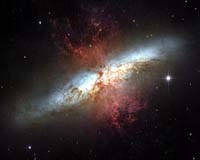
Hubble Captures Cigar At Sweet Sixteen
Baltimore MD (SPX) Apr 25, 2006 To celebrate the Hubble Space Telescope's 16 years in orbit, NASA and ESA have released this image of the starburst galaxy Messier 82. The mosaic image represents the sharpest wide-angle view ever obtained of M82. The galaxy is remarkable for its bright blue disk, webs of shredded clouds, and fiery-looking plumes of glowing hydrogen blasting out of its central regions. Throughout the galaxy's center, young stars are being born 10 times faster than they are in the Milky Way. The resulting huge concentration of young stars carved into the gas and dust at the galaxy's center. The fierce galactic superwind generated from these stars compresses enough gas to make millions of more stars. In M82, young stars are crammed into tiny but massive star clusters. These, in turn, congregate by the dozens to make the bright patches, or starburst clumps, as astronomers call them, in the central parts of M82. The clusters in the clumps can only be distinguished in the sharp Hubble images. Most of the pale, white objects sprinkled around the body of M82 that look like fuzzy stars are actually individual star clusters about 20 light-years across and contain up to a million stars. Astronomers think the rapid rate of star formation in this galaxy eventually will be self-limiting. When star formation becomes too vigorous, it will consume or destroy the material needed to make more stars. The starburst then will subside, probably in a few tens of millions of years. Located 12 million light-years away, M82 appears high in the northern spring sky in the direction of the constellation Ursa Major, the Great Bear. It is also called the Cigar Galaxy, because of the elliptical shape produced by the oblique tilt of its starry disk relative to its line of sight. Hubble completed the observation last month with its Advanced Camera for Surveys' Wide Field Channel, and astronomers assembled the six-image mosaic by combining exposures taken with four colored filters that capture starlight from visible and infrared wavelengths, as well as the light from the glowing hydrogen filaments. Hubble was launched on April 24, 1990, aboard space shuttle Discovery. Community Email This Article Comment On This Article Related Links Hubble Space Telescope Science Institute The Art of Space - Desktops and Eyecandy
 Hubble Captures Pair Of Nearby Strings Of Cosmic Jewels
 Baltimore MD (SPX) Apr 18, 2006
New images by the Hubble Space Telescope have captured the most detailed picture to date of the open star clusters NGC 265 and NGC 290 in the Small Magellanic Cloud � one of the Milky Way's nearest galactic neighbors. |
|
|

| The content herein, unless otherwise known to be public domain, are Copyright 1995-2006 - SpaceDaily.AFP and UPI Wire Stories are copyright Agence France-Presse and United Press International. ESA PortalReports are copyright European Space Agency. All NASA sourced material is public domain. Additionalcopyrights may apply in whole or part to other bona fide parties. Advertising does not imply endorsement,agreement or approval of any opinions, statements or information provided by SpaceDaily on any Web page published or hosted by SpaceDaily. Privacy Statement |