|
 |
 |
 |
 |
 |
 |
 |
 |

 |
Spitzer Catches Young Stars In Their Baby Blanket Of Dust
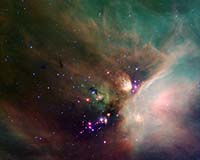
Pasadena CA (SPX) Feb 12, 2008 Newborn stars peek out from beneath their natal blanket of dust in this dynamic image of the Rho Ophiuchi dark cloud from NASA's Spitzer Space Telescope. Called "Rho Oph" by astronomers, it's one of the closest star-forming regions to our own solar system. Located near the constellations Scorpius and Ophiuchus, the nebula is about 407 light years away from Earth. Rho Oph is made up of a large main cloud of molecular hydrogen, a key molecule allowing new stars to form out of cold cosmic gas, with two long streamers trailing off in different directions. Recent studies using the latest X-ray and infrared observations reveal more than 300 young stellar objects within the large central cloud. Their median age is only 300,000 years, very young compared to some of the universe's oldest stars, which are more than 12 billion years old. "Rho Oph is a favorite region for astronomers studying star formation. Because the stars are so young, we can observe them at a very early evolutionary stage, and because the Ophiuchus molecular cloud is relatively close, we can resolve more detail than in more distant clusters, like Orion," said Lori Allen, lead investigator of the new observations, from the Harvard-Smithsonian Center for Astrophysics, Cambridge, Mass. This false-color image of Rho Oph's main cloud, Lynds 1688, was created with data from Spitzer's infrared array camera, which has the highest spatial resolution of Spitzer's three imaging instruments, and its multiband imaging photometer, best for detecting cooler materials. The colors in this image reflect the relative temperatures and evolutionary states of the various stars. The youngest stars are surrounded by dusty disks of gas from which they and their potential planetary systems are forming. These young disk systems show up as red in this image. Some of these young stellar objects are surrounded by their own compact nebulae. More evolved stars, which have shed their natal material, are blue. The extended white nebula in the center right of the image is a region of the cloud glowing in infrared light due to the heating of dust by bright young stars near the cloud's right edge. Fainter, multi-hued diffuse emission fills the image. The color of the nebulosity depends on the temperature, composition and size of the dust grains. Most of the stars forming now are concentrated in a filament of cold, dense gas that shows up as a dark cloud in the lower center and left side of the image against the bright background of the warm dust. Community Email This Article Comment On This Article Related Links Spitzer Stellar Chemistry, The Universe And All Within It
 Light Echoes Whisper The Distance To A Star
 Paris, France (SPX) Feb 12, 2008
Taking advantage of the presence of light echoes, a team of astronomers have used an ESO telescope to measure, at the 1% precision level, the distance of a Cepheid - a class of variable stars that constitutes one of the first steps in the cosmic distance ladder. |
|
|

| The content herein, unless otherwise known to be public domain, are Copyright 1995-2007 - SpaceDaily.AFP and UPI Wire Stories are copyright Agence France-Presse and United Press International. ESA Portal Reports are copyright European Space Agency. All NASA sourced material is public domain. Additional copyrights may apply in whole or part to other bona fide parties. Advertising does not imply endorsement,agreement or approval of any opinions, statements or information provided by SpaceDaily on any Web page published or hosted by SpaceDaily. Privacy Statement |