|
 |
 |
 |
 |
 |
 |
 |
 |

 |
Light Echoes Whisper The Distance To A Star
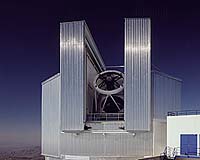
Paris, France (SPX) Feb 12, 2008 Taking advantage of the presence of light echoes, a team of astronomers have used an ESO telescope to measure, at the 1% precision level, the distance of a Cepheid - a class of variable stars that constitutes one of the first steps in the cosmic distance ladder. "Our measurements with ESO's New Technology Telescope at La Silla allow us to obtain the most accurate distance to a Cepheid," says Pierre Kervella, lead-author of the paper reporting the result. Cepheids are pulsating stars that have been used as distance indicators since almost a hundred years. The new accurate measurement is important as, contrary to many others, it is purely geometrical and does not rely on hypotheses about the physics at play in the stars themselves. The team of astronomers studied RS Pup, a bright Cepheid star located towards the constellation of Puppis ('the Stern') and easily visible with binoculars. RS Pup varies in brightness by almost a factor of five every 41.4 days. It is 10 times more massive than the Sun, 200 times larger, and on average 15 000 times more luminous. RS Pup is the only Cepheid to be embedded in a large nebula, which is made of very fine dust that reflects some of the light emitted by the star. Because the luminosity of the star changes in a very distinctive pattern, the presence of the nebula allows the astronomers to see light echoes and use them to measure the distance of the star. "The light that travelled from the star to a dust grain and then to the telescope arrives a bit later than the light that comes directly from the star to the telescope," explains Kervella. "As a consequence, if we measure the brightness of a particular, isolated dust blob in the nebula, we will obtain a brightness curve that has the same shape as the variation of the Cepheid, but shifted in time." This delay is called a 'light echo', by analogy with the more traditional echo, the reflection of sound by, for example, the bottom of a well. By monitoring the evolution of the brightness of the blobs in the nebula, the astronomers can derive their distance from the star: it is simply the measured delay in time, multiplied by the velocity of light (300 000 km/s). Knowing this distance and the apparent separation on the sky between the star and the blob, one can compute the distance of RS Pup. From the observations of the echoes on several nebular features, the distance of RS Pup was found to be 6500 light years, plus or minus 90 light years. "Knowing the distance to a Cepheid star with such an accuracy proves crucial to the calibration of the period-luminosity relation of this class of stars," says Kervella. "This relation is indeed at the basis of the distance determination of galaxies using Cepheids." RS Pup is thus distant by about a quarter of the distance between the Sun and the Centre of the Milky Way. RS Pup is located within the Galactic plane, in a very populated region of our Galaxy. Community Email This Article Comment On This Article Related Links ESO Stellar Chemistry, The Universe And All Within It
 Gargantuan Galaxy NGC 1132 - A Cosmic Fossil
 Paris, France (ESA) Feb 08, 2008
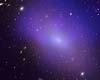
The NASA/ESA Hubble Space Telescope has captured a new image of the galaxy NGC 1132 which is, most likely, a cosmic fossil - the aftermath of an enormous multi-galactic pile-up, where the carnage of collision after collision has built up a brilliant but fuzzy giant elliptical galaxy far outshining typical galaxies. |
|
|

| The content herein, unless otherwise known to be public domain, are Copyright 1995-2007 - SpaceDaily.AFP and UPI Wire Stories are copyright Agence France-Presse and United Press International. ESA Portal Reports are copyright European Space Agency. All NASA sourced material is public domain. Additional copyrights may apply in whole or part to other bona fide parties. Advertising does not imply endorsement,agreement or approval of any opinions, statements or information provided by SpaceDaily on any Web page published or hosted by SpaceDaily. Privacy Statement |