|
 |
 |
 |
 |
 |
 |
 |
 |

 |
Spirit Wintering But Work Continues
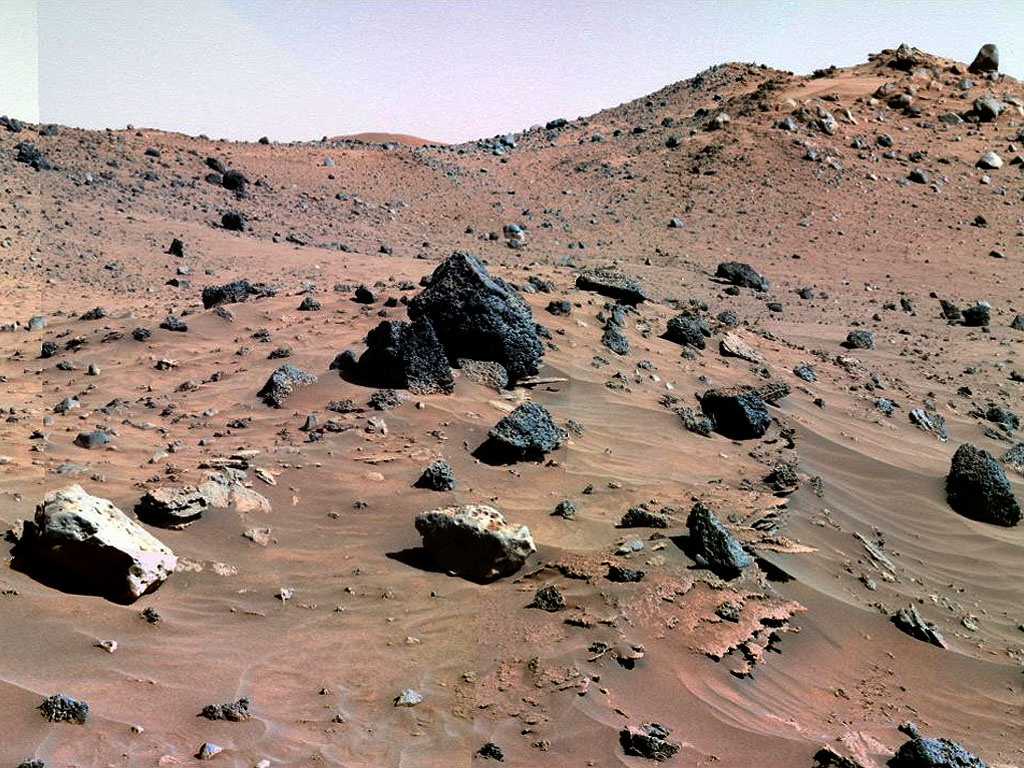
Pasadena CA (SPX) Jul 11, 2006 From its winter outpost at Low Ridge inside Gusev Crater, NASA's Spirit rover took this view of the nearby hilly, sandy terrain that includes two potential iron meteorites. The two light-colored, smooth rocks about two-thirds of the way up from the bottom of the frame have been labeled Zhong Shan and Allan Hills. Spirit acquired the image on the rover's 872nd Martian day, or sol (June 16), using exposures taken through three of the panoramic camera's filters, centered on wavelengths of 750 nanometers, 530 nanometers, and 430 nanometers. The image is presented in false color to emphasize differences among materials in the rocks and soil. The two rocks' informal names are in keeping with the rover science team's campaign to nickname rocks and soils in the area after locations in Antarctica. Zhong Shang is an Antarctic base that the People's Republic of China opened on Feb. 26, 1989, at the Larsemann Hills in Prydz Bay in East Antarctica. Allan Hills is a location where researchers have found many Martian meteorites, including the controversial ALH84001, which achieved fame in 1996 when NASA scientists suggested that it might contain evidence for fossilized extraterrestrial life. Zhong Shan was the given name of Sun Yat-sen (1866-1925), known as the Father of Modern China. Born to a peasant family in Guangdong, Sun moved to live with his brother in Honolulu at age 13 and later became a medical doctor. He led a series of uprisings against the Qing dynasty that began in 1894 and eventually succeeded in 1911. Sun served as the first provisional president when the Republic of China was founded in 1912. The Zhong Shan and Allan Hills rocks, at the left and right, respectively, have unusual morphologies and miniature thermal emission spectrometer signatures that resemble those of a rock known as Heat Shield at the Meridiani site explored by Spirit's twin, Opportunity. Opportunity's analyses revealed Heat Shield to be an iron meteorite. Meanwhile, Spirit has been busy receiving new flight software upgrades, both directly from Earth via the rover's high-gain antenna and indirectly via relay from NASA's Odyssey spacecraft. Engineer at Jet Propulsion Laboratory anticipate that all flight software upgrades will be on board the rover by early this week. Spirit has successfully completed a procedure to correct for drift in the inertial measurement unit, resulting in more accurate pointing of the miniature thermal emission spectrometer. Spirit remains healthy and continues to make progress on the rover's winter science campaign of experiments. Spirit's handlers planned to have the rover spend part of the weekend calibrating the brush on the rock abrasion tool, using images from the panoramic camera and hazard avoidance cameras to characterize dirt buildup on the instrument. Solar array input was down to about 290 watt-hours per sol (a hundred watt-hours is the amount of electricity needed to light one 100-watt bulb for one hour). Sol-by-sol summaries: Sol 889 (July 4): Spirit studied the rock target Halley with the M�ssbauer spectrometer. Sol 890: Spirit calibrated the elevation actuator (a motor that controls horizontal tilt) in the miniature thermal emission spectrometer. Sol 891: Spirit made observations with the miniature thermal emission spectrometer. Sol 892: Engineers transmitted an uplink of flight software files via X-band radio to the rover's high-gain antenna. Sol 893: Spirit calibrated and took images of the rock abrasion tool. Sols 894 to 896 (July 9 to 11): Plans call for Spirit to continue acquiring components of the 360-degree McMurdo Panorama. Odometry: As of sol 891 (July 6), Spirit's total odometry remained at 6,876.18 meters (4.27 miles). Community Email This Article Comment On This Article Related Links Mars Rovers at JPL Mars Rovers at Cornell Mars News and Information at MarsDaily.com Lunar Dreams and more
 On Mars No One Can Hear You Scream
 University Park PA (SPX) Jul 10, 2006
It may be difficult for two people to have a conversation on Mars, according to a research paper by Amanda Hanford and Lyle Long of the aerospace engineering department at Penn State University. |
|
|

| The content herein, unless otherwise known to be public domain, are Copyright 1995-2006 - SpaceDaily.AFP and UPI Wire Stories are copyright Agence France-Presse and United Press International. ESA PortalReports are copyright European Space Agency. All NASA sourced material is public domain. Additionalcopyrights may apply in whole or part to other bona fide parties. Advertising does not imply endorsement,agreement or approval of any opinions, statements or information provided by SpaceDaily on any Web page published or hosted by SpaceDaily. Privacy Statement |